


Behind the grand white façade of Queensland’s Government House are stories most visitors would never guess — of fortunes made and lost, ambitious plans that never came to pass, and the men and women who left their mark on the house long before and after it became an official residence.
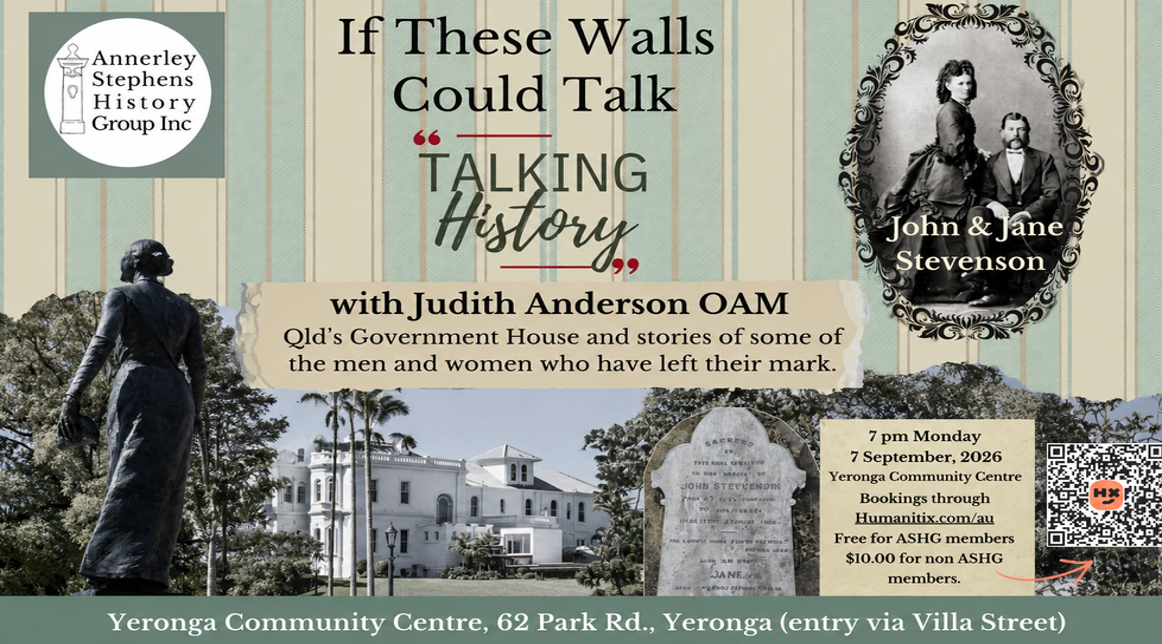
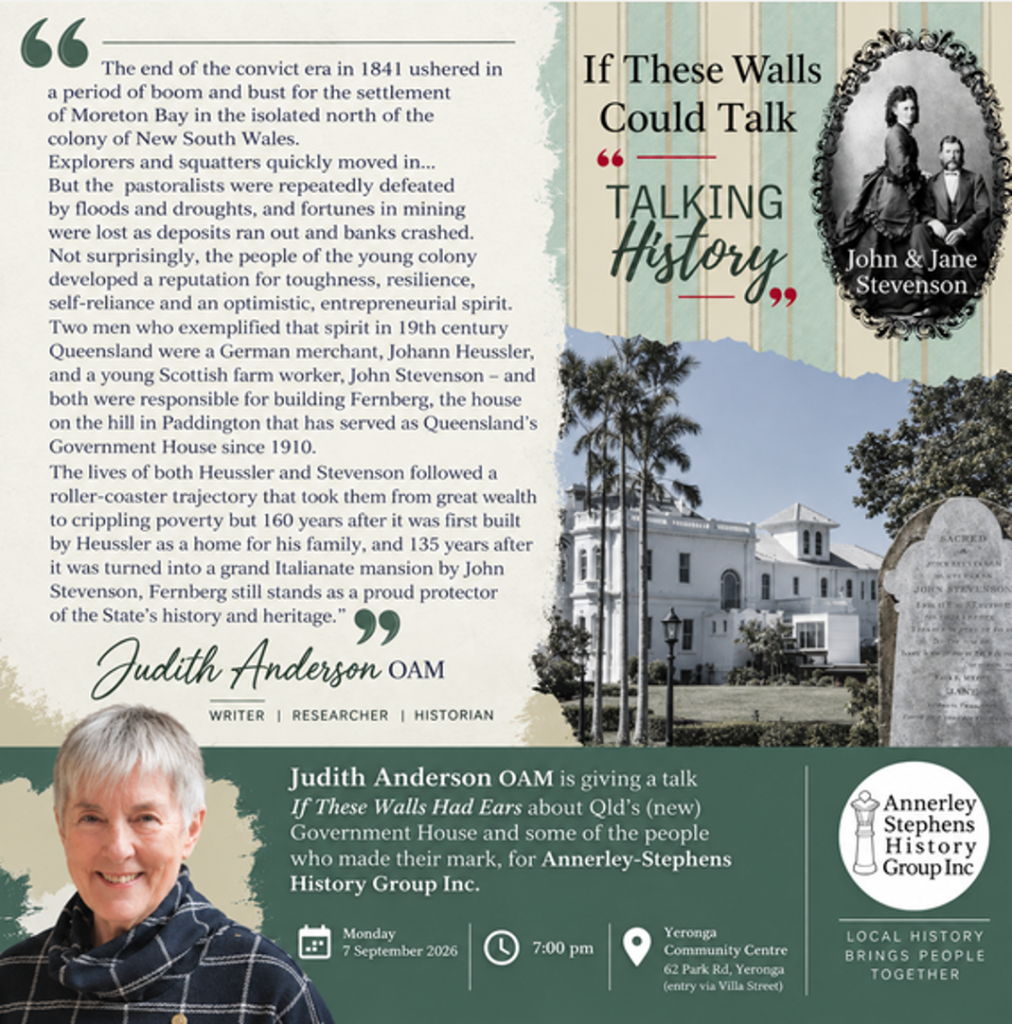
On Monday, 7 September, some of those stories will come to Yeronga when writer, researcher and longtime Government House volunteer guide Judith Anderson OAM presents If These Walls Could Talk for the Annerley-Stephens History Group.
Anderson’s illustrated Talking History presentation at Yeronga Community Centre from 7:00pm will use historic and contemporary photographs to look beyond Fernberg’s formal role and into the lives connected with the heritage-listed estate.

There is plenty to uncover. Fernberg was a private home for decades before it became Government House, one of its wealthy owners experienced an extraordinary reversal of fortune, and even a striking stained-glass figure watching over its staircase has a story of its own.
Before Fernberg became Government House
Fernberg was already decades old before a Queensland governor lived there.
The house was built in 1865 for merchant and politician Johann Christian Heussler and later acquired by pastoralist, businessman and parliamentarian John Stevenson.
Stevenson commissioned prominent Brisbane architect Richard Gailey to substantially enlarge the residence. Major extensions in 1889–90 transformed the earlier villa, creating much of the imposing Italianate mansion familiar today.

One particularly personal piece of Stevenson’s Fernberg remains inside.
The Scottish-born pastoralist commissioned a life-sized stained-glass representation of Robert the Bruce, King of Scots, which still occupies a prominent position above Fernberg’s grand cedar staircase.
Stevenson himself has another story to tell. The wealthy pastoralist and parliamentarian who oversaw Fernberg’s transformation would later experience a dramatic reversal of fortune.
Exactly where that story led is among the history best left to Anderson to tell.
The temporary Government House that stayed
Fernberg’s path to becoming Government House was not straightforward either.
Queensland’s original Government House stood in George Street. After a decision was made to make that building available to the newly established University of Queensland, Fernberg was selected as a temporary residence for the governor.
Governor Sir William MacGregor moved there in 1910.
There were plans for a purpose-built Government House elsewhere in Brisbane, but the permanent residence originally envisaged did not eventuate. Instead, the Queensland Government purchased Fernberg in 1911.
More than a century later, that supposedly temporary choice remains the official residence of Queensland’s governor.
It is a broad chronology containing many more stories than the official role of the building might suggest — and those people, rather than simply the architecture, have become an important part of Anderson’s research.
Years spent researching the people behind the house
Anderson’s connection with Fernberg extends beyond showing visitors through the historic residence.
Her research has included the people associated with Government House, and she was publicly acknowledged for her research when a gallery dedicated to the spouses of Queensland’s governors was officially opened at Fernberg in 2018.
Born and raised in Warwick and educated at The University of Queensland, Anderson has worked in Australia and internationally across a varied career. She was awarded the Medal of the Order of Australia in 2012 for service to women and the arts.
She is also the author of Earning a Crust: A Century of the Baking Trade in Warwick (1860s–1960s).
At Yeronga, her focus will turn to Fernberg and the stories of some of the men and women who left their mark on one of Queensland’s most significant historic residences.
If These Walls Could Talk
Talking History with Judith Anderson OAM will be held on Monday, 7 September 2026, from 7:00pm to 8:00pm at Yeronga Community Centre, 62 Park Road, Yeronga, with entry via Villa Street.
The event is presented by the Annerley-Stephens History Group. Admission is free for members and $10 for non-members.
Bookings are available through Humanitix.
Published on 2-September-2026