The Park Road rail station in Dutton Park is being rechristened as the Boggo Road rail station. The change reflects the station’s integration with the Boggo Road busway, creating a major transport hub where passengers can seamlessly transfer between the Beenleigh, Gold Coast, and Cleveland rail lines and bus services.
The upcoming Cross River Rail project will further enhance the station’s significance by adding two new underground rail platforms. Translink collected customer feedback that indicated a strong preference for a unified name at this location.
Translink, Queensland Rail, and the Cross River Rail Delivery Authority collaborated on the name change, receiving overwhelming support from key stakeholders.
The rebranding process kicked off this week with the installation of new signage, and further platform signage and computer systems will be updated over the next six to twelve months.
Minister for Transport and Main Roads, Bart Mellish, emphasised that the government is not only making public transport more affordable with the introduction of 50-cent fares but also actively improving the network’s user-friendliness.
He stated that the name change directly responds to customer feedback and aims to make the network easier to navigate.
The Minister highlighted Boggo Road as an iconic landmark and stressed that the change is all about simplifying travel for Queenslanders.
Claims abound about Johnny Cash, the iconic “Man in Black,” performing at Boggo Road Gaol in Dutton Park, in the early 1970s, stirring both fascination and scepticism among fans and historians alike.
More than 45 years since Johnny Cash came to Australia in 1971, a story still persists that he visited Boggo Road Gaol, the most notorious prison in Queensland during that time, to perform for a select group of inmates.
The narrative, fueled by memories of retired prison officer Bill Eaddows, suggested Mr Cash played within the gaol’s confines, bringing his music directly to those living in the shadow of the state’s heavy-handed justice system, under the watchful eye of Premier Joh Bjelke-Petersen’s administration.
Mr Cash, no stranger to the prison environment with his performances in American facilities like Folsom and San Quentin, allegedly sought to extend his advocacy for prison reform internationally, choosing Boggo Road as a venue not once, but reportedly twice, in the early ’70s.
A Musical Family’s Australian Journey
Verifying the specifics is challenging due to the scarcity of records, such as historical correspondences, which have long been lost. The late Mr Eaddows remembered Mr Cash’s performances at Boggo Road Gaol twice in the 1970s, likely during ’71 and ’73, coinciding with his tours in Australia. Due to a rigorous ban on photography within prison walls at the time, no visual evidence of these events exists.
On the evening of 29 March 1971, Mr Cash had a show at Brisbane’s Festival Hall. This performance is believed to have occurred on the same day he visited Boggo Road Gaol, marking the finale of his Australian tour before departing for New Zealand.
Accompanying the singer to Australia were his wife, June Carter, and six members of her illustrious country music family, The Carters. Alongside them was Johnny and June’s one-year-old son, John, with the family traversing Australia in a caravan.
Advocacy Behind Bars
By the early 1970s, Mr Cash emerged as the foremost figure advocating prison reform. Drawing inspiration from the life of Jesus, whom he greatly admired, Mr Cash leveraged his fame to foster positive change. According to Mr Eaddows, this advocacy led him to perform at Boggo Road Gaol.
The inmates present at his performance likely had no prior knowledge of Mr Cash’s visit, as such an event would have required discreet and advanced planning. A former inmate suggested that Mr Cash might have corresponded with one of the prisoners, indicating a personal connection to the cause.
Photo Credit: Adam French/Google Maps
This behaviour was consistent with the singer’s approach to his tours; he often made unpublicised visits to prisons across the globe, including facilities in Sweden and Germany, totalling over 20 and, by some accounts, as many as 30 prisons. During these visits, he performed for the inmates and engaged with them personally, responding to their letters and listening to their stories.
Mr Dawson’s investigation, prompted by inquiries and the recounting of supposed witnesses, ultimately revealed these stories as potentially fabricated. This conclusion is supported by responses from former staff and inmates who collectively deny the event’s occurrence.
Despite the allure of Mr Cash’s legendary status and his known prison tours, Mr Dawson’s research suggests that the Boggo Road performances are more likely a part of local lore, a myth perpetuated without substantial evidence.
Yet the intrigue surrounding Johnny Cash’s connection to Boggo Road Gaol highlights the enduring impact of his legacy, not only as a musician but as a figure of cultural significance, whose life and work continue to inspire debate and investigation.
Whilst the truth of his presence at Boggo Road may remain elusive, the story itself speaks volumes about Mr Cash’s lasting influence and the intersection of music, justice, and history in Australia’s collective consciousness.
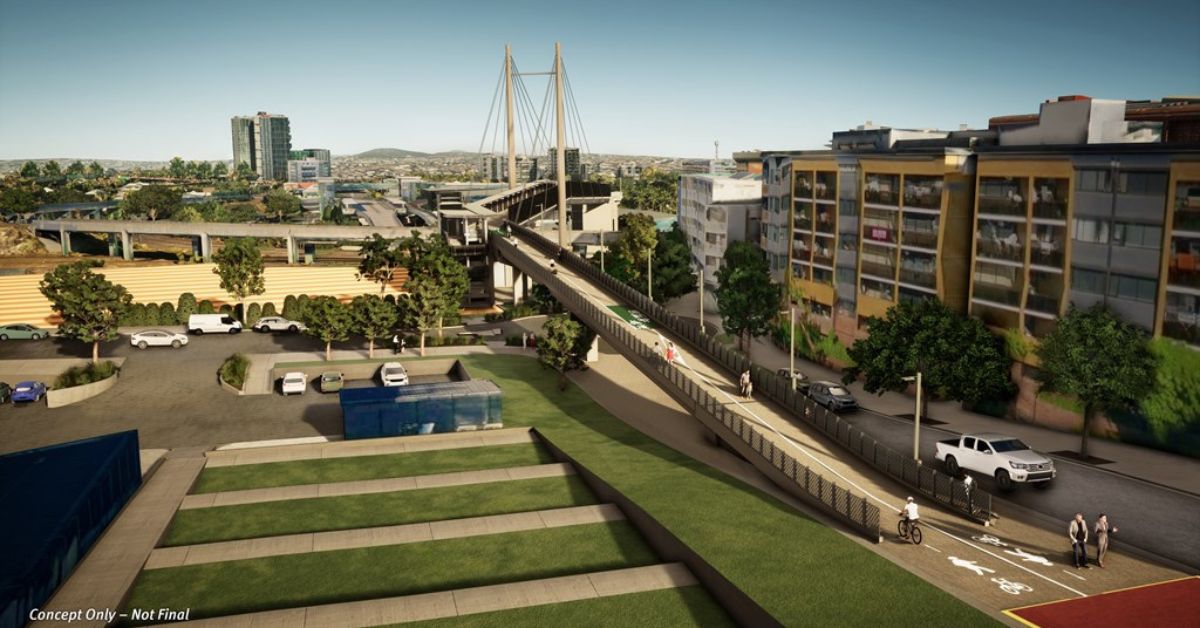
The new Boggo Road Bridge is a pedestrian and cycling bridge that will become an “iconic part of the local landscape,” according to Transport and Main Roads Minister Mark Bailey. Thus, it needs a good name recall.
“It is only fitting that the community is invited to contribute ideas to name the bridge, which will be a standout piece of infrastructure that crosses over the rail lines to connect communities,” Mr Bailey added.
“The bridge could be named after someone local, who has themselves helped to better connect the community; someone linked to health, science or education; or even a name that honours local First Nations culture.”
“Next we’ll start to see concreting works and installation of reinforced steel and formwork, to be followed by girders being installed by an 800-tonne-capacity crane, and finally the bridge deck being constructed within 2023.”
Development is about to start at the multi-purpose precinct encompassing the new Boggo Road Village, where Stockwell has enlisted a heritage architect to help preserve some of the historical facets of the prison next door.
Instead of a major demolition, an agreement has been reached between Stockwell and supporters of heritage-listed sites to retain a detention unit cell block of the Boggo Road Gaol. This will mean that visitors to the upscale multi-purpose precinct beside it will still get a glimpse of Brisbane’s darkest history.
Stockwell, architect Ruth Woods, and the Department of Environment and Science heritage team will work to preserve and protect the 1980s-era cell block, the fronts of the isolation cells, the walkway of the cell block, the guard tower, stairs, and some of the walls.
The agreement comes following the controversial approval of Stockwell’s plans for a village centre next to the heritage-listed site in 2021, with community groups appealing the decision in the Planning and Environment Court. (DA A005260979)
Jack Sim, a well-known Boggo Road Prison historian, tour guide, and author, welcomes the development after Stockwell listened to the recommendations of heritage groups. The cell block to be restored has been inaccessible for many years but once the village is completed, the historical site will be added to the guided tours.
But then this would mean that Sim’s guided tours will be temporarily shut down, at least for six months, while the construction of the new Boggo Road Village is ongoing.
Meanwhile, the Boggo Road Village development will also be anchored by an IGA. The commercial and retail sites will include medical and allied health services, aside from the dining precincts.
Photo Credit: StockwellPhoto Credit: Stockwell
Stockwell expects to complete the project by 2023. About 60 per cent of its tenancy has been secured prior to the site’s construction.
A development application has been lodged for a mixed-use development that aims to activate the Boggo Road precinct and complement local tourism offers for the Boggo Road Gaol in Dutton Park.
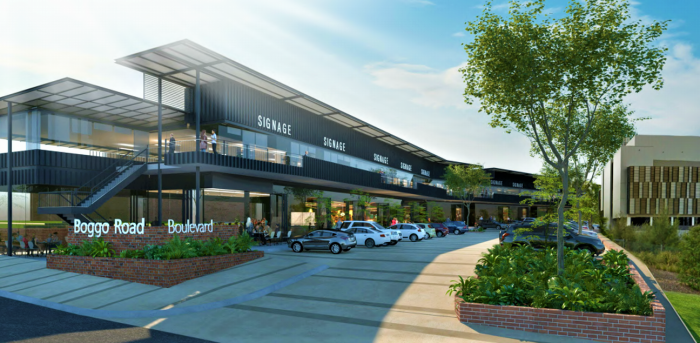
The proposed Boggo Road Urban Village, designed by Buchan Group, will consist of retail and commercial tenancies within a two-storey building with basement and ground level parking, situated between Boggo Road Gaol and the CSIRO Ecosciences building.
Photo Credit: Brisbane City Council / pdonline.brisbane.qld.gov.au
Stockwell Development Group’s proposed development site is located at 21 and 41 Boggo Road, the area being referred to as “Boggo Road Boulevard,” covering a total of 2,712sqm. The ground level will contain the retail development whilst the commercial development will be at the first level.
“The proposed development provides an exciting boutique commercial development to activate the Boggo Road precinct and create the Boggo Road Gaol site as a key destination in the Brisbane south landscape,” the John Gaskell Planning Consultants Assessment report said.
Proposed detail plan | Photo Credit: Brisbane City Council / pdonline.brisbane.qld.gov.au
“While there has been a significant amount of government infrastructure spending within the precinct to date, it currently lacks activity, is isolated from commercial activities, and lacks the activation expected of what will become a major transport hub in the future.”
Photo Credit: Brisbane City Council / pdonline.brisbane.qld.gov.auPhoto Credit: Brisbane City Council / pdonline.brisbane.qld.gov.au
Lift and staircases will be provided between the two levels. There will be 163 car park spaces (155 cars, 3 PWC, 4 Van, 1 SRV). Vehicle access will be via two crossovers, one to Boggo Road and another one to Peter Doherty Street. Also a separate driveway crossover will be provided on Boggo Road to facilitate vehicular access to the basement level car parking.
Photo Credit: Brisbane City Council / pdonline.brisbane.qld.gov.au
The proposal will involve the demolition of the 1976 and 1987/88 Building 17 walkway and the detention units, adjoining the eastern side of the gaol, which do not form part of the gaol tours.
Perspective view of northern corner | Photo Credit: Brisbane City Council / pdonline.brisbane.qld.gov.au
The Heritage Impact report prepared by Ruth Woods, however, indicates that ‘these buildings are not currently maintained and demonstrate considerable issues with water penetration, concrete spalling and corrosion of the steelwork’’ and that the development will not diminish the cultural heritage significance of the place.
Heritage impact render – Annerley Road | Photo Credit: Brisbane City Council / pdonline.brisbane.qld.gov.au
“The new building is contemporary in form yet sympathetic in scale to the gaol. The new works are reversible, and the bulk of the new mixed use retail and commercial building is outside the State heritage boundary for the site,” the Heritage Impact report said.