How Old Is That Apple? Why Australian Apples Can Stay Crisp for Months

By Jack Mercer – Rabbit Hole Fisherman

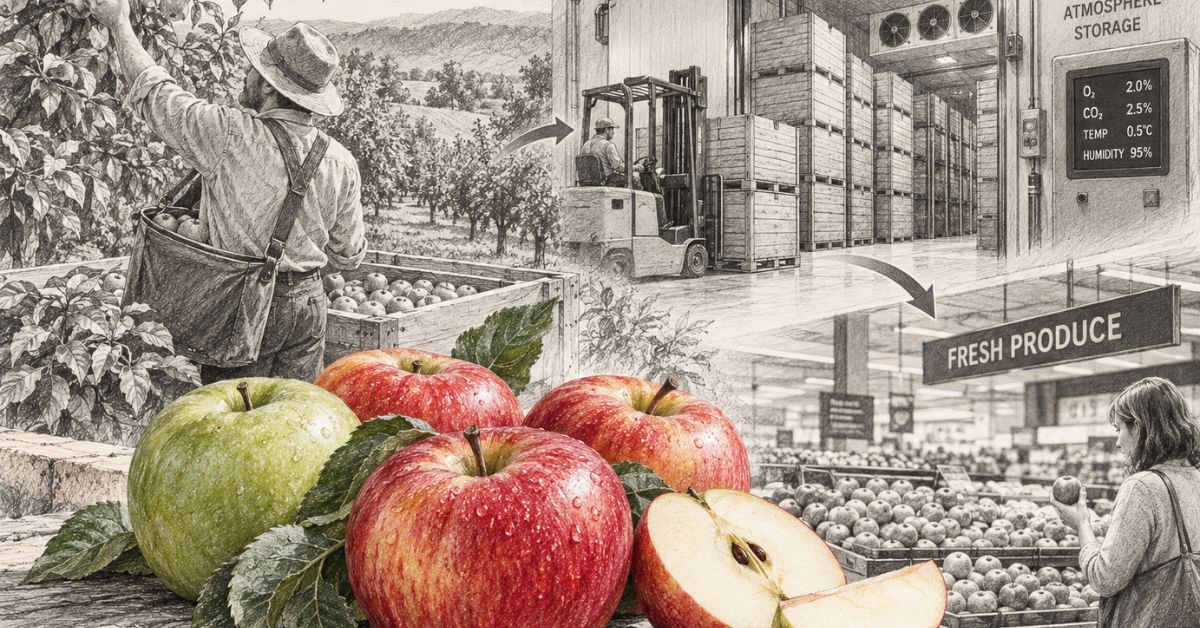
An apple can spend months in carefully managed storage before it reaches the fruit bowl. That does not mean every supermarket apple is months old, or that stored fruit is necessarily poor quality. The interesting part is how growers slow the ageing of fruit that remains alive after harvest.

An apple is one of the simplest things you can buy at the supermarket. Pick one up, check for bruises, perhaps give it a gentle squeeze, and put it in the trolley.

There is little to suggest that it might have a longer history than the shopping trip. It could have been picked recently. Depending on the variety, season and supply chain, it could also have been harvested months earlier. Both apples might look much the same.

In January 2026, ABC News reported on storage at the Orange Fruit Growers Co-operative in central New South Wales. Its reporting described controlled-atmosphere technology capable of keeping suitable apples in storage for periods approaching 12 months. That is an upper-end capability under appropriate conditions, not a claim that Australian apples typically spend a year in storage.

To understand the technology, start with a detail that is easy to overlook. An apple is still alive after it has been picked.

The apple doesn’t stop working when it leaves the tree

Once harvested, an apple no longer receives water and nutrients from its tree, but its cells continue to function. The fruit uses oxygen and releases carbon dioxide through respiration, drawing on stored energy. Changes associated with ripening also continue.

Ethylene, a naturally occurring plant hormone, plays an important role in apple ripening. Over time, the fruit’s firmness, aroma and balance of sugars and acids can change. Some changes improve eating quality; eventually others contribute to deterioration.

Commercial storage aims to slow those changes so that the fruit reaching a customer still has the texture and flavour expected of its variety. Temperature is one part of the answer. The air surrounding the apple is another.

A very sophisticated refrigerator

Cooling apples slows their metabolism. Commercial facilities also manage humidity to reduce moisture loss. But refrigeration alone has limits, which is why the apple industry uses controlled-atmosphere storage.

Ordinary air contains about 21 per cent oxygen. In a controlled-atmosphere room, operators reduce oxygen and manage carbon dioxide while maintaining suitable temperatures. Under the right conditions, this slows respiration and ripening. The fruit is not frozen or preserved like canned food. It remains biologically active, but at a reduced rate.

There is a balance to maintain. Too little oxygen can trigger undesirable changes in the fruit; excessive carbon dioxide can damage some varieties. Appropriate settings depend on variety, maturity at harvest and the intended storage period. Advanced systems, sometimes called dynamic controlled atmospheres, adjust conditions in response to indicators of how the fruit is behaving.

It takes more than putting apples in a cold room and leaving them there. The operator is managing a living crop throughout storage.

From the orchard to the following season

Australian apple harvests occur largely in the first half of the year, although the timing varies with growing region and variety. Shoppers can buy Australian-grown apples well beyond that period because storage extends the selling season.

An Australian apple purchased in spring may therefore have been harvested months earlier. That is a possibility, not a way to calculate the age of any particular apple. Different varieties, businesses and supply chains have different storage arrangements.

Cold storage also has a long history. Growers once relied on cellars and other naturally cool spaces to keep produce after harvest. Today’s controlled-atmosphere rooms bring refrigeration, gas monitoring and more precise management to the same basic problem: how to slow deterioration without spoiling the fruit.

The treatment that changes how apples respond to ethylene

Another postharvest technology is 1-methylcyclopropene, usually shortened to 1-MCP. Ethylene helps regulate ripening by interacting with receptors in fruit cells. 1-MCP interferes with that response, which can delay some changes associated with ripening, including softening.

This is different from using a substance to kill mould. Its purpose is to influence the fruit’s ripening response. In Australia, relevant 1-MCP products are regulated by the Australian Pesticides and Veterinary Medicines Authority and must be used according to their approved conditions.

The fact that the treatment exists does not mean every apple receives it. Use depends on the product, variety, producer and storage plans. Nor can a shopper determine from an apple’s appearance whether it has been treated. The important consumer fact is that postharvest treatments and atmospheric storage are distinct technologies, sometimes used as part of a broader storage program.

Why some apples turn floury

Most apple eaters have encountered the disappointing one: attractive skin, but flesh that feels soft, dry or granular rather than crisp and juicy.

That texture is often called mealiness. An apple’s crunch depends partly on how its cells and cell walls behave when bitten. During ripening and storage, changes in cell walls and the material connecting cells can affect whether the flesh fractures crisply or separates in a softer, more granular way.

Variety, harvest maturity and storage conditions all influence texture. Some varieties hold firmness better than others. Controlled-atmosphere storage is intended to delay quality loss, not to cause it. An apple that has been stored for months can still be crisp, while an apple with an appealing exterior can disappoint when cut open.

Does storage change nutrition?

It would be tempting to assume an apple picked yesterday must be nutritionally superior to one stored for several months. The evidence is more complicated.

Apples vary naturally in their nutritional composition. Variety, growing conditions, maturity and handling all matter. During storage, levels of particular compounds, including some vitamins and phenolic substances, may change. The amount and direction of change depend on what is being measured and the conditions involved.

That does not establish that stored apples are nutritionally equivalent to newly harvested apples. Equally, the duration of storage alone does not prove that an apple has become nutritionally poor. Dietary fibre remains one of the reasons apples are useful in the diet, even though some other characteristics can change over time.

Texture, flavour and nutrient levels are related aspects of quality, but they do not necessarily change at the same rate. A firm apple is not a laboratory test of its vitamin content.

Why the label doesn’t tell you when it was picked

Country-of-origin information can tell shoppers whether an apple was grown in Australia. It does not, by itself, identify the harvest date.

An Australian-grown apple might have been harvested recently or kept in storage. The origin statement cannot settle that question. Nor can its colour or firmness reliably reveal the date it left the tree.

Commercial growers and distributors may hold harvest and storage records, but the information normally displayed to consumers serves other purposes. This article makes no claim that retailers are generally required to display an individual apple’s harvest date. The applicable labelling requirements should be assessed separately from a consumer’s interest in that information.

If the harvest date matters to you, ask the seller or buy directly from a grower who can provide it. Buying local may make that conversation easier, but ‘locally grown’ is not automatically the same thing as ‘recently picked’.

The variety matters as much as the room

Long storage begins with decisions made in the orchard. Varieties differ in their rates of ripening, response to storage atmospheres and susceptibility to disorders. Harvest maturity matters too. Fruit picked too early may not develop the desired eating quality; fruit picked too late may have reduced storage potential.

Growers must judge when to harvest, how to handle the fruit and whether it is suited to extended storage. The storage facility then manages temperature, humidity and atmospheric conditions. A crisp apple on the supermarket shelf can be the result of many careful decisions made months before it is purchased.

What can shoppers actually do?

The most useful distinction is between an apple’s age and its eating quality. They are related, but not interchangeable.

Choose apples that are firm and free from obvious bruising or deterioration. Learn which varieties offer the sweetness, acidity and texture you enjoy. At home, refrigeration generally helps apples retain their quality longer than leaving them in a warm kitchen. Handle them gently: damage to the flesh can occur even when the skin appears mostly intact.

If you want to know when an apple was picked, ask. Don’t try to infer a harvest date from a shiny skin or a satisfying crunch.

A different understanding of fresh

There is a considerable amount of science behind the ordinary act of buying a crisp apple outside the harvest season. Fruit may be picked in autumn, moved into refrigerated storage, held in a carefully controlled atmosphere and released for sale months later. Throughout that period it remains alive, respiring slowly as its quality is managed.

We often use ‘fresh’ to mean ‘recently harvested’. With apples, the word can also describe fruit that has retained good eating quality through storage. Those ideas overlap, but they are not identical.

The next time you bite into a crisp Australian apple in spring, you probably won’t know exactly when it left the tree. Its crunch may owe something to the grower, the variety and an unusually sophisticated storage room.

How Fleetwood Mac’s “The Chain” Became Formula 1’s Signature Sound

By Jack Mercer – Rabbit Hole Fisherman

Five musicians, relationships under strain and a song assembled from discarded pieces: this is how Fleetwood Mac created a recording that millions would recognise without necessarily knowing its name.

For generations of Formula 1 fans, it has been one of the most recognisable sounds in sport.

In This Story

A bass guitar begins playing a low, insistent pattern. The drums gather momentum. Then an electric guitar comes roaring in, and suddenly you are thinking about racing cars, starting grids and Sunday afternoons in front of the television.

It is a thrilling piece of music. And for many people, that is where the familiarity ends. They know the sound and what it means, but might struggle to name the song.

The music is the closing section of Fleetwood Mac’s The Chain, from their 1977 album Rumours. Its history is almost as extraordinary as the circumstances in which it was recorded.

The five musicians responsible were working through considerable personal difficulties. Lindsey Buckingham and Stevie Nicks were separating, John and Christine McVie’s marriage was ending, and Mick Fleetwood’s marriage was under strain. Yet the group continued to record together.

Somehow, they produced one of rock’s most successful albums. Hidden among its more conventional songs was a remarkable musical puzzle: a composition that took shape from fragments and extensive studio work.

Five musicians who had to keep working together

Fleetwood Mac began in Britain in 1967 as a blues band associated with guitarist Peter Green. Mick Fleetwood and John McVie were central to its early sound. Christine McVie later joined, adding a distinctive voice and gift for melody.

At the end of 1974, American musicians Lindsey Buckingham and Stevie Nicks joined. Their arrival helped reshape the group’s sound and commercial fortunes. The self-titled 1975 album brought international success with songs including Rhiannon, Say You Love Me and Over My Head.

By the time Rumours was being made, the band had become bigger, more ambitious and far more complicated. Making its successor meant bringing five people into the studio at a moment when several of their closest relationships were breaking down.

The situation is sometimes presented as an uninterrupted soap opera. That would diminish the work. Whatever their personal disagreements, these were highly capable musicians who could still listen, arrange, revise and perform together.

That combination of tension and discipline would define the record. The Chain would become the clearest example of it.

The song that started with an ending

During the Rumours sessions at the Record Plant in Sausalito, California, the group worked on a Christine McVie composition called Keep Me There, also associated with the working title Butter Cookie.

According to co-producer and engineer Ken Caillat, the musicians struggled to make the recording cohere. But during work on the track, John McVie came up with a compelling bass passage. The band built an energetic instrumental ending around it, with Buckingham adding guitar.

They had found something worth keeping. What they did not yet have was a finished song.

Caillat recalled that the group returned to the material repeatedly over many months. Its most exciting section was also its most awkward problem: how could the rest of the composition lead convincingly into that ending?

Late in the sessions, Buckingham devised a way forward. Rather than preserve the existing verses, he reworked the structure. Caillat described cutting blank tape into the recording, replacing sections, recording a new bass-drum pulse and changing the arrangement. Buckingham also played Dobro and reshaped the chorus.

This was analogue recording, not a digital workstation. Engineers physically edited multitrack tape, and the musicians built the finished performance from material recorded at different stages.

The Chain was not simply captured as one uninterrupted band performance. It was painstakingly assembled.

A song credited to everyone

The official songwriting credits for The Chain name all five members: Lindsey Buckingham, Mick Fleetwood, Christine McVie, John McVie and Stevie Nicks. It is the only track on the original Rumours album credited to the entire group.

Those credits are a more reliable guide than any attempt to assign each person one neat, exclusive piece of the finished song. Firsthand accounts describe an overlapping process of writing, arrangement, playing and editing, and recollections can differ in emphasis.

What is clear is that the finished recording depended on contributions from across the band, as well as the production work that brought them together.

There is an irony in that. People struggling to sustain their personal relationships found a way to make disconnected musical pieces function as a whole. But that is an observation about the finished work, not proof that all five intended a single symbolic message.

Rumours arrives

Released in February 1977, Rumours included Dreams, Go Your Own Way, Don’t Stop, You Make Loving Fun and Gold Dust Woman. It reached No. 1 in major markets and became one of the biggest-selling albums in recording history.

On the original LP, The Chain opened side two, following Christine McVie’s quiet Songbird at the end of side one. The contrast was striking.

The Chain begins with a measured pulse, acoustic textures and interwoven voices. It gradually builds, but its most familiar moment comes after the vocal sections have ended.

Then John McVie’s bass line takes over.

The passage works not because it is technically showy, but because of its tone, repetition and momentum. Fleetwood’s drums build around it; Buckingham’s electric guitar turns the ending into a release of accumulated tension.

The band’s official expanded Rumours editions include versions of Keep Me There and a demo of The Chain. These provide unusually direct evidence of how the musical ideas evolved.

Yet the musicians could hardly have anticipated the recording’s second life.

How The Chain became the sound of Formula 1

In 1978, the BBC adopted the closing instrumental section of The Chain for its Formula 1 television coverage.

The fit was immediate. The bass line creates anticipation; the drums add urgency; the guitar-led ending supplies a climax suited to pictures of racing cars and starting grids.

The association lasted through the BBC’s coverage until 1996. When ITV took over British Formula 1 broadcasting in 1997, it used other music.

When Formula 1 returned to BBC television in 2009, The Chain returned too. Its revival was greeted as the restoration of a familiar part of the viewing experience.

Channel 4 retained the music when it assumed Britain’s free-to-air coverage in 2016. But the association was not unbroken: reporting in 2019 documented Channel 4’s move away from The Chain as its signature theme.

The important point is not that one broadcaster used the same recording continuously forever. It is that a section of an album track became so closely linked to a sport that its return could itself become news.

A song with two lives

Music often escapes the circumstances of its creation. A song written about a relationship can become associated with a film, a family event or a sporting moment. Listeners attach their own memories to it.

The Chain has two particularly vivid identities.

On Rumours, it is part of a record made by five musicians working through a turbulent period. The structure itself bears the marks of experimentation and collaboration.

On television, its closing instrumental section signalled anticipation, speed and the start of a Grand Prix.

Those meanings are not in competition. They demonstrate how an arrangement can acquire a cultural life its creators never planned.

The title invites another tempting interpretation. A chain consists of separate links, and this was the only original Rumours track credited to all five members. But the history is stronger when we do not force every note into an allegory about the band’s relationships. The accounts of its creation are complicated enough — and interesting enough — on their own.

The recording that nearly didn’t come together

Return to the studio in 1976. There is a promising ending, an unfinished song and months of effort behind it. The band keeps trying. Sections are removed, new passages recorded and the structure rebuilt.

Caillat’s recollections show how close the material came to being abandoned as an unsatisfactory experiment.

Eventually, it works.

That would already be a satisfying ending to the story. But the more improbable development came later, when a British broadcaster found an entirely different purpose for its final instrumental passage.

The next time you hear The Chain, do not skip straight to the famous bass line. Start at the beginning. Hear the measured rhythm, the acoustic guitar, the voices and the gradual build.

When the bass arrives, the ending can seem inevitable.

It was not.

It took repeated attempts, inventive playing, physical tape editing and a band determined to complete a recording despite difficult circumstances.

Millions of people know how The Chain ends. Far fewer know how it was put together.

And that may be its greatest surprise: the music so many people associate with racing cars came from a song whose creators were working hard simply to make its separate pieces fit.

Walking Japan’s Kumano Kodo: The Old Road Through the Cedars

By Jack Mercer – Rabbit Hole Fisherman 

Japan’s Kumano Kodo links mountain shrines by forest paths and village roads. Walking the Nakahechi route means steep climbs, small inns and local guides who can point out what a visitor might otherwise miss.

In This Story

The meaning of “ninety-nine”

The ninety-nine shrines are not necessarily ninety-nine shrines.

Along Japan’s Kumano pilgrimage roads, the smaller oji shrines are collectively called the Kyujukyu Oji, the Ninety-nine Oji. The local tourism bureau says the number expresses abundance rather than an exact count. These shrines helped protect and guide pilgrims, offering places to worship and rest between the grand shrines ahead.

It is a useful reminder that this walk rewards more than counting kilometres. A modest roadside shrine can matter as much as a mountain view.

A route through living country

Kumano Kodo names a network of pilgrimage routes through the Kii Peninsula in southern Honshu. The popular Nakahechi route connects the Kumano grand shrines and can be walked in consecutive days or shorter sections. It has mountain villages, local buses and an established network of accommodation.

That makes it appealing to travellers whose Japan has mostly been train stations and cities. A day on foot ends somewhere people live, with time to learn a little about the place before moving on.

Sacred places, shared paths

There is more history here than any single itinerary can hold. The UNESCO World Heritage property, inscribed in 2004, brings together sacred sites at Kumano Sanzan, Koyasan and Yoshino and Omine, along with their connecting pilgrimage routes. UNESCO describes a tradition of sacred mountains stretching back more than 1,200 years.

A visitor does not need the religious knowledge of a pilgrim. Curiosity is enough, provided it comes with respect for people who are there to worship. These are active sacred places, shared with hikers whose immediate concerns may be sore feet and lunch.

Takijiri-oji to Takahara

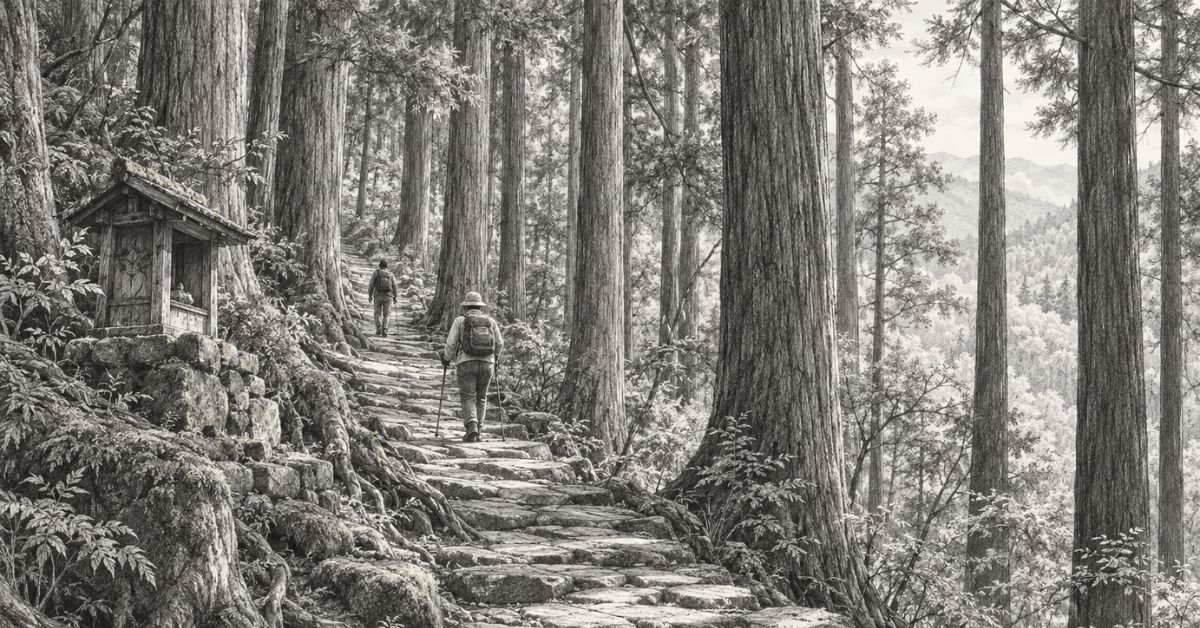
For walkers starting at Takijiri-oji, the mountain section begins quickly. The route to Takahara is only about four kilometres, yet the Tanabe City Kumano Tourism Bureau allows two to three hours and lists about 430 metres of total ascent. It climbs through native and planted forest to a village overlooking the Hatenashi mountains. Takahara’s shrine stands among giant camphor trees.

Four kilometres can sound modest over breakfast. Here the elevation column deserves equal billing.

Why a guide helps

The forest also deserves proper attention. This is country with a long human history, including planted woodland, not a vast untouched forest conveniently fitted with an ancient trail. Villages and cultivated land are part of the experience. The appeal comes from travelling between them slowly enough to notice the transitions.

A local storyteller can make those transitions more meaningful. In a first-person account for Meguri Japan, writer Chiho Kuriyama walked from Hosshinmon-oji towards Kumano Hongu Taisha with guide Emiyō Katō, described as locally born and raised and part of the Kumano Hongu Storytellers’ Circle. [5]

The people in the story

Among the figures Katō brings into the journey is Fujiwara no Teika, the poet who accompanied retired emperor Go-Toba on pilgrimage. As Katō explained it, Teika went ahead to arrange meals and accommodation. His journal also recorded how difficult he found the journey.

That is a welcome detail among emperors and sacred destinations. Someone had to organise where everyone slept. Someone also complained about the walking. The past becomes easier to picture when its inhabitants have responsibilities and aching legs, instead of appearing only as names on a noticeboard.

Lodging as part of the walk

A map can show where a path goes. A knowledgeable companion can explain why a small place along it mattered to the people coming through. The bureau lists local guiding services and advises checking for national or regional guide qualifications.

Accommodation shapes the walk too. A minshuku is generally a small family-run guesthouse, often with Japanese-style rooms and shared bathing facilities. Ryokan inns vary more widely in size and style, with many offering tatami rooms and futons, and some providing beds. Meals and facilities differ between properties.

Dinner, breakfast and the next day

For walkers, those differences matter beyond the booking photographs. The room is where clothes get sorted for the next day and the route is reconsidered in light of how today actually went. Staying several nights in different small places also gives the journey a sequence of hosts, rather than a single resort staff.

Australian writer Benjamin Law’s Nakahechi account for Qantas Travel Insider includes a stay at Hatago-Masara, then run by a French-Japanese couple. He described meals that reflected that combination, including French beef stew at dinner and Japanese dishes at breakfast. Elsewhere along his walk, the hosts and styles of accommodation varied.

Booking ahead matters

The practical side has limits. The bureau warns against arriving in mountain settlements without accommodation booked: rooms are limited, and a property may be closed or have no food prepared if it has no reservations. Meals often begin around six in the evening.

Those arrangements deserve more thought than an optimistic estimate of walking speed. A host preparing dinner needs to know who is coming. Food preferences and dietary needs belong in that conversation before arrival, when there is time to establish what can be provided.

Luggage, shuttles and shorter walks

Luggage transfers can make the walk less burdensome. The bureau’s community booking system offers daily services between eligible accommodation, allowing walkers to carry only a day pack. It currently specifies booking at least twenty days ahead and ties online shuttle reservations to accommodation booked through KUMANO TRAVEL.

Near Hongu, the Hosshinmon-oji section offers a shorter way to experience the route. The official course is about 7.5 kilometres, usually allowing two to three hours. It passes through villages and forest, with tea plantations and terraced fields around Fushiogami. At Fushiogami-oji, pilgrims traditionally knelt after catching their first view of the grand shrine below.

Hongu, flood and renewal

Kuriyama and Katō’s account describes taking longer over their walk. That is hardly a failure of the official estimate. Stopping to listen is part of the reason to have a storyteller along. It also gives the shorter walk a different value from simply covering less ground than someone else.

The destination itself has changed in ways that are easy to miss when a place is introduced as ancient. Kumano Hongu Taisha once stood at Oyunohara, a sandbank near the meeting of two rivers. A severe flood in 1889 destroyed many buildings, and surviving structures were rebuilt at the present site.

Oyunohara and the present shrine

Oyunohara remains sacred. Its enormous torii gate, 33.9 metres high, was erected in 2000 and is made of steel.

The dates belong beside each other. A pilgrimage tradition can be old while the structures serving it are repaired, relocated or newly built. Looking for an entirely unchanged past would mean missing much of what kept this place in use.

At the present Hongu shrine, even the bark roofs need renewing. The bureau says Japanese cypress bark is replaced at intervals of forty to fifty years, work dependent on traditional materials and skilled craftspeople. Preserving the shrine means continuing to work on it.

Yunomine Onsen

The same is true of Yunomine Onsen. Pilgrims used its waters for purification before worship at Hongu. The village’s small Tsuboyu bath occupies a cabin beside the creek, and the hot spring connection continues in the shrine’s spring festival rites. There is also a public hot-water cooking basin where visitors can cook eggs.

Sacred bathing and a practical use for hot water occupy the same small village. A tired walker can appreciate the bath without claiming to have had a revelation. Knowing its older purpose adds something to the experience without dictating what anybody must feel.

The long way to Nachi

Reaching Hongu is enough for some itineraries. Those continuing towards Nachi have further mountain walking ahead, including the Kogumotori-goe and Ogumotori-goe sections through Koguchi. On the latter, heading from Koguchi towards Nachi, the route gains about 800 metres in its first five kilometres. The climb is known as Dogiri-zaka, translated by the bureau as the Body-breaking Slope.

There is little ambiguity in that name.

The whole Ogumotori-goe section is about fourteen kilometres, with roughly 1,260 metres of total ascent and an estimated seven to nine hours of walking. It crosses three passes, and there are no restaurants along the trail. Those figures are a better guide to the day than a photograph of an inviting stone path disappearing among cedars.

Wet stones and tired legs

Wet stones and roots need care. The bureau warns that old cobbled steps can become particularly slippery, and advises against walking during extreme weather. This is a supported walking destination, but still a mountain environment. Current conditions matter more than how easily a previous visitor completed it.

Law found the final day of his Nakahechi walk especially hard on the legs. His experience helps explain why the evening comforts belong in the story. They let travellers recover enough to enjoy the next day, and give people a reason to linger in the communities between the climbs.

Arrival at Nachi

At Nachi, the landscape itself helps explain the pilgrimage. Kumano Nachi Taisha’s religious origins lie in worship of the waterfall, Nachi-no-Otaki, which drops 133 metres from the forest above. Nearby Seiganto-ji is a Buddhist temple closely associated with the Shinto shrine. The relationship between belief and the natural world becomes visible in a specific place, rather than staying as a paragraph of history.

For the visitor, arrival can be ordinary as well as moving. There are arrangements for getting to the next town and the question of where to sleep. Nobody is obliged to produce a profound verdict on the walk before attending to either.

Closing note

Teika had meals and lodgings to organise centuries ago. Today’s walker has much more help available, and can spend longer over the shrines and the stories. On the steep sections, though, the old complaints still make sense.

Singapore Engineering Problems: Dating Algorithms, Fertility, Reading and AI Infrastructure

By Jack Mercer – Rabbit Hole Fisherman

Singapore is experimenting with dating algorithms, paying people to read, preparing for a super-aged society and positioning capital around the infrastructure of the AI age. Taken together, those moves point to a governing instinct that is unusually consistent: identify a problem early, test an intervention, measure the result, and keep adjusting.

In This Story

That is not the same as saying Singapore is “solving” these problems. It is saying something more specific: the state is unusually willing to treat social and economic drift as something that can be diagnosed, prototyped and, sometimes, corrected.

That instinct is visible in several current experiments.

If you are a young, unmarried public servant, Singapore’s Government Technology Agency may now help find you a date.

The pilot is called FirstDate. It asks participants 30 questions and then attempts to pair them using the Gale-Shapley stable matching algorithm — a piece of mathematical work associated with Lloyd Shapley, who shared the 2012 Nobel Memorial Prize in Economic Sciences.

This is not a Tinder-style scroll through endless profiles. The system deliberately presents one match at a time.

Singapore has started with its own workforce: unmarried public officers aged 21 to 35. GovTech says the scheme is an experiment and has not decided whether it will be expanded beyond the pilot.

Taken alone, that might sound like a quirky tech story.

Placed alongside Singapore’s other current interventions, it looks more revealing.

According to official demographic data from Population.gov.sg, Singapore has become a super-aged society: 21.4 per cent of its citizen population is now aged 65 or older, up sharply from a decade ago. At the same time, Singapore’s preliminary resident fertility rate fell to 0.87 children per woman in 2025, the lowest in its recorded history, with 27,393 resident births.

Meanwhile, the National Library Board has launched a five-year campaign encouraging people to read for at least 15 minutes a day, with streaks, points and small rewards. ReadSG is designed less as a literary movement than as a behavioural nudge.

And about 4,800 kilometres away, near Dalby in Queensland, a Singapore-based developer is behind one of the largest proposed digital infrastructure projects Australia has seen: the Western Downs Digital Park, where Anthropic has signed a long-term lease commitment.

There is an important distinction here.

The Western Downs project should not be described as being financed by the Singapore Government. It is being developed by Singapore-based Zerra DC, which says it is backed by privately held infrastructure investor AGP Group, in a consortium that also includes Australian Data Centres and Macquarie Capital.

Separately, Singapore’s sovereign wealth manager GIC has entered a data-centre infrastructure partnership with Macquarie Asset Management and Anthropic. That platform, called Theseus Infrastructure, is initially focused on developing Anthropic-leased data centres in the United States.

The two arrangements are distinct. What connects them is not a single stream of Singapore government financing, but the increasingly visible presence of Singapore-based developers, private capital and sovereign investment around the global AI infrastructure build-out.

At first glance, these stories appear unrelated.

Dating.

Reading.

Ageing.

Artificial intelligence.

But underneath them sits a remarkably consistent idea about government: identify a problem early, measure it, test an intervention, and be willing to spend money or deploy technology to change the trajectory.

That philosophy has been visible in Singapore for decades.

What has changed is the nature of the problems.

A country that cannot afford to drift

Understanding Singapore’s approach requires understanding Singapore itself.

It is a small island state with limited land, no natural resources to speak of and a population of just over six million.

Many countries can absorb a policy mistake.

Singapore has historically had less margin for error.

Water is the clearest example.

Singapore describes itself as one of the world’s most water-stressed countries. Rather than simply accept that disadvantage, it developed what it calls the Four National Taps: local catchments, imported water, reclaimed NEWater and desalination.

It also prices water to reflect scarcity and uses regulation and incentives to encourage conservation. More on that approach is set out by the Singapore Ministry of Sustainability and the Environment.

Traffic produced a similarly engineered response.

Singapore introduced an Area Licensing Scheme for congestion charging decades ago and replaced it with Electronic Road Pricing in 1998. Charges vary with traffic conditions in an attempt to keep roads moving at target speeds. A satellite-based successor, ERP 2, is now being introduced.

Neither policy is directly transferable to every other country.

That is not really the point.

The point is the governing instinct.

Singapore tends to treat apparently intractable problems as systems with levers:

change the price,
change the incentive,
change the infrastructure,
change the information available to people,
run a pilot,
measure what happens,
then adjust.

That approach is now colliding with a new generation of problems for which governments around the world have few proven answers.

The fertility problem money hasn’t solved

The dating experiment makes more sense when viewed against Singapore’s demographic arithmetic.

A fertility rate of 0.87 is extraordinarily low.

Without migration, a population needs roughly 2.1 births per woman over the long term to replace itself.

Singapore’s government has described the demographic situation in unusually serious language. Deputy Prime Minister Gan Kim Yong told parliament in February that falling fertility posed an “existential challenge” to the country’s society, economy and security. The relevant statements and policy context are laid out in Population.gov.sg’s demographic pages.

Singapore has certainly tried financial support.

This year it announced a substantial expansion of family assistance. Its new SG Child Support Package will provide up to S$62,000 for every Singapore citizen child, with total eligible government support of around S$70,000 from birth to age 17 when continuing programmes are included.

Yet fertility has continued to fall.

That creates an uncomfortable policy question.

What if the cost of children is not the only bottleneck?

Before people have children, they generally have to meet. Relationships have to form. People have to marry, or at least decide to build families.

Singapore says marriage rates have also declined.

That is where FirstDate becomes more than a novelty.

It is an attempt to intervene further upstream.

Can mathematics improve dating?

The algorithm behind FirstDate was not invented for dating apps.

David Gale and Lloyd Shapley published their work on stable matching in 1962.

The problem is deceptively simple. Imagine two groups of people, each with preferences about members of the other group. How do you arrange matches so there is no pair who would both prefer each other over the partners they received?

The Gale-Shapley algorithm produces what mathematicians call a stable matching.

Variants of stable matching have since been applied to problems such as matching doctors to hospitals and students to schools.

Singapore is now experimenting with the concept for relationships.

There is, however, an important limitation that some coverage can obscure.

The algorithm cannot calculate love.

It cannot predict whether two people will laugh together.

Nor can it manufacture attraction.

It can only organise stated preferences in a structured way.

And that may be precisely why the experiment is interesting.

The intervention is not really saying, “Government has solved dating.”

It is asking a narrower question: could the design of modern dating platforms themselves be making it harder for some people to form relationships?

FirstDate deliberately restricts choice. Instead of hundreds of profiles, there is one introduction.

GovTech says the pilot is testing whether greater weight on shared preferences and values — combined with fewer potential matches — prompts participants to take an introduction more seriously.

That is almost the reverse of the dominant commercial dating-app model, which tends to maximise selection and engagement.

Singapore is experimenting with scarcity.

Then there is the reading experiment

Another modern problem has attracted a remarkably modest intervention:

read a book.

For 15 minutes.

Singapore’s National Library Board launched ReadSG in September as a five-year effort to encourage lifelong reading. Details of the initiative have been reported by The Straits Times.

Participants can record reading sessions, build streaks and earn virtual coins and rewards through the government’s CrowdTask SG platform.

The sums involved are tiny. Reports on the scheme say a reader receives 20 virtual coins for a qualifying daily session, with 1,000 coins equivalent to S$1.

Nobody is likely to supplement their income by reading Tolstoy.

Which suggests the money is not really the point.

The reward is a behavioural nudge.

Singapore already does something similar with exercise. Its government-developed Healthy 365 system awards points for behaviours including walking, logging meals and choosing healthier foods. Those points can be exchanged for vouchers and credits.

Now that model is being applied to reading.

And again there is a larger question hiding inside the programme itself.

What happens when technologies engineered to capture human attention become better at doing so than institutions designed to encourage concentration?

Singapore’s answer, at least experimentally, is to fight behavioural technology with behavioural technology.

Streaks against scrolling.

Points against notifications.

Gamification against gamification.

The striking contradiction

There is an intriguing contradiction running through all of this.

Singapore is simultaneously trying to become an important participant in the AI economy and trying to mitigate some of the social problems created by a more digital world.

Its refreshed Smart Nation strategy explicitly acknowledges that digital technology produces both opportunities and new social challenges. See Smart Nation 2.0.

The government has also established a National AI Council chaired by Prime Minister Lawrence Wong, while its updated National AI Strategy describes its objective as “AI for the Public Good.” The strategy is set out on Smart Nation Singapore’s National AI Strategy page.

At the same time, Singapore is considering restrictions on social-media access for children under 13 and age-appropriate platform requirements for teenagers, including possible restrictions on features such as infinite scrolling and autoplay. No final framework has yet been announced. The government’s current position is outlined in the Ministry of Digital Development and Information’s response.

In June, its new Online Safety Commission also began operating with powers aimed at giving victims faster remedies against specified online harms. The legal framework is summarised by the Ministry of Law.

Singapore is therefore not simply embracing technology.

It is trying to govern the consequences of technology while remaining economically embedded in technological development.

That distinction matters.

And then there is Dalby

The Australian connection takes the story onto a different scale.

Near Dalby on Queensland’s Western Downs, Singapore-based Zerra DC is proposing the Western Downs Digital Park.

The numbers are enormous.

The proposed campus could ultimately deliver up to 1.44 gigawatts of IT capacity across four stages. Anthropic, creator of the Claude AI system, has entered into a long-term lease commitment associated with the development. The project remains subject to planning and regulatory approvals. Project details are available on the Western Downs Digital Park site, with additional reporting from ABC News.

Australian reporting has put the proposed investment at approximately A$32 billion.

This is not an office building for an AI company.

It is industrial-scale computational infrastructure.

At its proposed scale, reporting has estimated that the facility could draw electricity equivalent to roughly 1.5 million average Australian households.

The proposal says it would connect directly to the high-voltage network at the existing Braemar substation. Its proponents say project-specific connection infrastructure would be funded by the project, that Anthropic intends to contract for additional renewable generation and storage, and that the facility would use closed-loop air cooling rather than conventional evaporative server cooling to minimise operational water requirements.

Those claims will be tested through Australia’s planning, energy and regulatory processes.

The ownership and financing distinction remains important.

Western Downs is a commercial project proposed by a consortium led by Singapore-based Zerra DC. Zerra says it is backed by privately held AGP Group. Australian Data Centres and Macquarie Capital are also consortium members.

That does not make the project a Singapore Government-funded data centre.

Singapore’s sovereign connection to Anthropic lies elsewhere.

Singapore’s sovereign capital is betting on AI infrastructure too

In August, Anthropic announced a separate strategic partnership with Macquarie Asset Management and GIC, Singapore’s sovereign wealth manager. Macquarie’s announcement is here: Anthropic, Macquarie Asset Management and GIC Theseus Infrastructure partnership.

They established a platform called Theseus Infrastructure to develop purpose-built data centres leased to Anthropic.

GIC and Macquarie-managed funds are expected to provide the majority of the equity for those projects, initially focusing on the United States.

Theseus and Western Downs are separate ventures and should not be conflated.

Viewed together, however, they reveal something broader.

Singapore-linked private developers and infrastructure capital are appearing in major AI projects abroad, while Singapore’s sovereign investment apparatus is independently positioning capital around the same global infrastructure transformation.

That fits a much older Singapore strategy.

The country does not have huge oil reserves.

It does not have vast mineral deposits.

It has instead accumulated enormous pools of financial capital and invests globally.

Singapore’s Ministry of Finance says government assets are principally managed through GIC, the Monetary Authority of Singapore and Temasek, with investment decisions undertaken professionally and commercially rather than directed project-by-project by ministers. That framework is described by the Ministry of Finance.

GIC’s mandate is explicitly long-term: preserve and enhance the international purchasing power of Singapore’s reserves. The ministry’s description of that mandate is here.

So while many governments are asking what AI will do to them, Singapore’s public and private investment ecosystem is also asking a different question:

where will the physical infrastructure behind AI be built, and who will own it?

That is a considerably more consequential question.

The pattern

Put these apparently unrelated stories together and Singapore starts looking less peculiar.

The dating app is not really about dating.

The reading rewards are not really about S$1.

And the ageing strategy is not just about elderly people.

The investments surrounding AI are not simply technology investments.

They are responses to four strategic problems:

demography: too few children and rapidly increasing longevity

human behaviour: digital systems competing more effectively for people’s attention

economic survival: maintaining high-value activity in a country with limited land and natural resources

technological disruption: ensuring Singapore is not merely a consumer of the next industrial transformation

There is also a fifth ingredient: experimentation itself.

Singapore has become unusually comfortable with government prototypes.

An illuminating example appeared this year in a different field. A government team spent two years testing an alternative road-pricing technology called ERP X with 403 citizen testers. According to the project’s published account at ERP X, the technology worked — and the government decided not to deploy it.

The team then published what it had learned and described the exercise as an experiment in how governments could test national infrastructure before committing to it.

Failure — or at least non-deployment — can therefore be part of the process.

That matters when assessing something as unusual as FirstDate.

The correct question is not necessarily whether Singapore believes it has discovered an algorithm capable of fixing its fertility crisis.

It clearly has not.

The more interesting question is whether governments should be willing to run relatively small experiments when conventional solutions are not working.

There is another side to this model

None of this means Singapore has discovered the formula for government.

Its approach raises legitimate questions.

How far should governments attempt to influence private behaviour?

At what point does a helpful nudge become paternalism?

Should the state be involved in dating at all?

How much personal information should citizens provide to government-backed digital systems?

Can an algorithm based on declared preferences meaningfully improve something as complicated as human attraction?

Do tiny financial incentives create lasting reading habits, or merely reward people who would have read anyway?

And can a country simultaneously champion enormous AI infrastructure investments while managing the social consequences generated by increasingly powerful digital technologies?

Those are not arguments against Singapore’s policies.

They are the questions by which the experiments should eventually be judged.

There is also a structural reason Singapore cannot simply be treated as a template for Australia, Britain or the United States.

It is a compact city-state.

Government can coordinate infrastructure, transport, housing and digital identity in ways that become much harder across sprawling federations containing multiple levels of government.

Its political and institutional traditions are also distinctive.

Copying individual Singapore policies without acknowledging those differences would miss much of the story.

But perhaps other countries can copy the question

Singapore’s most interesting export may therefore not be any single policy.

It may be a habit of mind.

When something important starts moving in the wrong direction, Singapore tends to ask: what could government actually do about it?

Water shortage? Recycle wastewater, desalinate seawater, capture more rainfall and price water around scarcity.

Congestion? Charge road use according to demand.

Physical inactivity? Turn walking into points.

Declining reading? Turn books into streaks and rewards.

Online harm? Create a specialised regulatory and relief mechanism.

People not forming relationships? Try redesigning online matchmaking.

AI becoming strategically important? Develop a national strategy and position public and private capital around the infrastructure supporting it.

None of this guarantees success.

Singapore’s fertility numbers are powerful evidence that even a determined government cannot simply engineer its way out of every social problem. Indeed, the fact that fertility has continued falling despite years of intervention may be the most important warning in the entire story.

Human beings are not traffic flows.

Relationships are not water systems.

Culture is not infrastructure.

The world’s smallest laboratory

And perhaps that is what makes Singapore worth watching.

Its physical size makes the country look small on a map.

As a policy laboratory, it is considerably larger.

The problems now confronting Singapore are increasingly the problems confronting wealthy societies everywhere: people living longer, fewer babies being born, technology consuming more attention, AI consuming extraordinary quantities of electricity and capital, and governments wondering how much they can realistically influence any of it.

Singapore’s response is unusually active.

Sometimes the intervention is measured in tens of billions of dollars.

Sometimes it is an algorithm.

Other times it is a S$1 reading reward.

The scale changes.

The instinct does not.

Find the problem. Build something. Test it. Measure it. Change it if necessary.

That approach can produce policies outsiders find ingenious.

It can also produce policies they find intrusive, eccentric or excessively technocratic.

Sometimes both descriptions are true.

But in an era when many governments can spend years discussing a problem before deciding who should commission the report into it, Singapore offers a fascinating counterexample.

It behaves, remarkably often, as though modern problems are not merely things governments must manage.

They are things governments should attempt to solve.

And with ageing populations, collapsing fertility, artificial intelligence and the battle for human attention rapidly moving from abstract future concerns to present-day realities, the rest of the world may discover soon enough whether Singapore has been over-engineering society —

or simply confronting tomorrow’s problems earlier than everyone else.

The Cables That Keep the World Connected

By Jack Mercer – Rabbit Hole Fisherman

Almost everything we do online depends on cables on the ocean floor. Here is how they got there, who owns them and what happens when they break.

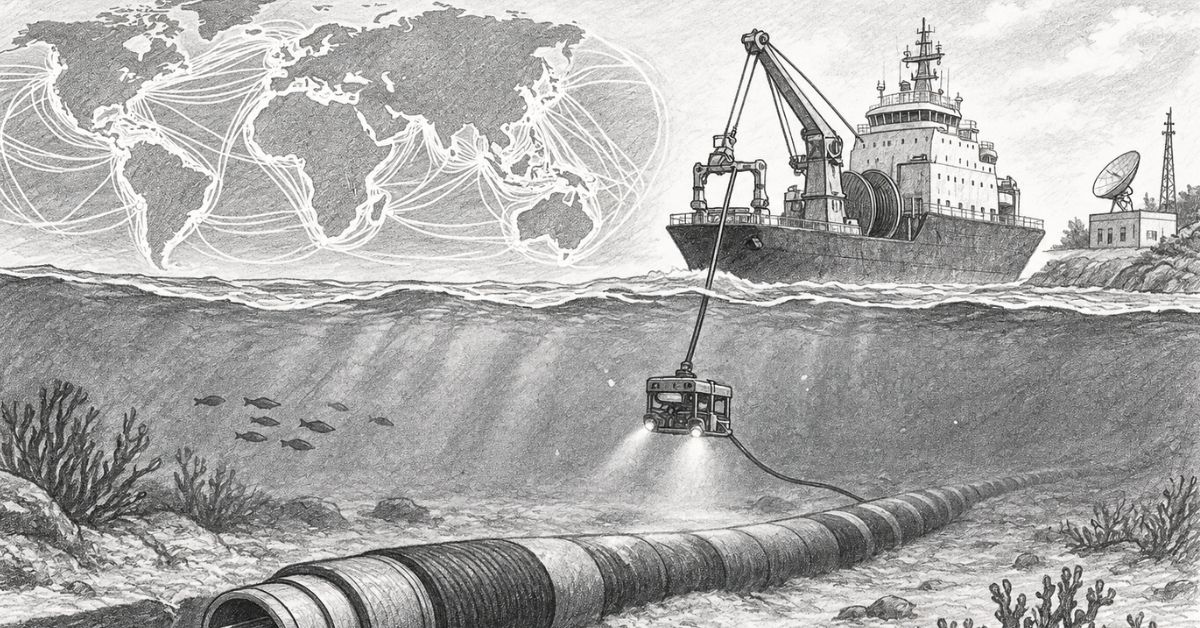
Off the Australian coast, a cable no thicker than a garden hose disappears beneath the sea. It may run for thousands of kilometres before reaching another continent.

In This Story

Inside are glass fibres carrying video calls, banking instructions, emails and data between the world’s data centres.

The internet may feel wireless. Between continents, it is mostly wired.

Submarine fibre-optic cables carry most intercontinental data traffic. Satellites are essential in remote areas and in emergencies, but they cannot yet match the capacity of the global undersea network.

What is often forgotten is how physical the system remains. Hundreds of cable systems cross the oceans. They must survive deep water, shifting seabeds, fishing gear, ship anchors and earthquakes. When something goes wrong, a specialist vessel may have to recover the cable and splice it back together.

This is the story of how a Victorian engineering gamble became one of the foundations of modern life.

The message that took sixteen hours

In the 19th century, news crossing the Atlantic travelled by ship. Governments, merchants and newspapers waited days or weeks for information that now arrives in seconds.

The electric telegraph transformed communications on land, but the Atlantic remained a barrier. A cable had to be manufactured, loaded aboard ships and laid across a seabed whose contours were still only partly known.

Cyrus West Field, an American businessman, became one of the key organisers of the effort. After several attempts, a telegraph cable connected Ireland and Newfoundland in August 1858. Queen Victoria sent a message to US President James Buchanan. Transmission took around 16 hours — slow by modern standards, fast by the standards of the day.

The cable failed within weeks.

A durable transatlantic connection was established in 1866. It changed the practical meaning of distance. Diplomatic instructions, financial news and commercial information could move between continents without waiting for a ship.

The technology was far less capable than modern fibre optics, but the central idea has endured: if information needs to cross an ocean reliably and at scale, a physical connection works.

How a cable became the internet

Early submarine cables carried telegraph signals through copper conductors. Later systems carried telephone calls. Modern cables use optical fibres — hair-thin strands of glass that guide pulses of light.

An undersea cable is more than a bundle of glass. It has protective layers, and long-distance systems use powered optical repeaters at intervals to maintain signal strength. Near shore, where anchors and fishing gear pose greater danger, cables can be armoured and buried beneath the seabed. In deep water, many lie directly on the ocean floor.

The amount of information they carry is hard to picture. Modern systems can transmit many terabits per second, depending on cable design and transmission equipment. A terabit is one trillion bits.

Even so, the cable remains a physical object. The electronics may be advanced, but the ocean has not become any gentler.

How much cable is out there?

TeleGeography maintains a widely used map and database of submarine cable systems. Its 2026 map shows hundreds of systems worldwide, including active and planned projects. That distinction matters: a planned route is not the same as a cable already carrying traffic.

The International Cable Protection Committee estimates the global telecommunications cable network extended to roughly 1.7 million kilometres by 2025. Such figures change as new systems are installed and older ones are retired.

The network is not evenly spread. Some countries have multiple separate routes and landing stations. Others depend on only a few connections. Two places can both be connected and face very different consequences when a cable fails.

What really breaks them?

A damaged cable can sound like the opening of an espionage thriller. In practice, the most common causes are more ordinary.

Industry data points to fishing activity and ship anchors as major causes of cable faults. ICPC publications on cable faults Natural hazards, including earthquakes and underwater landslides, also cause damage. Technical faults occur as well.

The International Cable Protection Committee commonly reports about 150 to 200 cable faults globally a year, although counts vary by period and dataset. That does not mean the global internet fails hundreds of times. Operators usually have alternative routes and can reroute traffic while repairs are organised.

What matters is where a failure occurs, which systems share the affected area and how much spare capacity exists elsewhere.

Two times the seabed made the news

In December 2006, a powerful earthquake south of Taiwan damaged several submarine cables. Communications traffic across parts of Asia was disrupted, and repairs took time because multiple systems had been affected. The event showed how a natural disaster can hit connections that look separate on a map but run through the same vulnerable corridor.

Tonga suffered a different disaster in January 2022. The Hunga Tonga–Hunga Ha’apai volcanic eruption and tsunami damaged the country’s international submarine cable, severely disrupting communications. Restoration required specialist repair work in difficult conditions.

The lesson is that cable resilience is not just about the number of routes on a map. Geography matters. So do repair arrangements, landing stations and alternative communications.

How do you repair a cable on the ocean floor?

First, engineers identify the approximate location of the fault using measurements from the cable system. A specialist repair ship then travels to the area.

Depending on depth, seabed conditions and the nature of the damage, the crew may use grapnels or remotely operated equipment to locate and recover the cable. A damaged section is cut away, replacement cable is spliced in and the repaired system is tested. The cable is then returned to the seabed and, where appropriate, reburied.

It is painstaking work. Repairs can be delayed by storms, distance, vessel availability and permissions to operate in particular waters. Where several cables are damaged at once, the available repair fleet may face competing demands.

A cable failure in a heavily connected market may barely register with consumers. For an isolated island, the wait for repairs can disrupt business, education, government services and family communications.

Why not use satellites instead?

Satellite broadband has transformed connectivity for remote communities, vessels and aircraft. It can also provide a useful backup when other infrastructure fails.

But it is not a simple substitute for submarine fibre.

Major intercontinental routes require vast capacity. Fibre-optic cables are well suited to moving that volume between fixed points. Satellites face limits in spectrum, capacity, equipment and the economics of serving large numbers of users.

That is why the spread of low-Earth-orbit satellite services has not stopped companies investing in submarine cables. The technologies complement each other. One offers reach and redundancy where the other is hard to install; neither makes the other irrelevant.

Who owns the ocean’s information highways?

Historically, telecommunications carriers built many international cables through consortia. They shared construction costs and gained rights to use the resulting capacity.

Today the picture includes some of the world’s biggest technology companies. Google, Meta, Microsoft and Amazon have invested in submarine cable infrastructure, sometimes through consortia and sometimes through projects tied closely to their own networks.

There is a practical reason. Companies running cloud services, search engines, social platforms and data centres need to move huge volumes of data between continents.

Ownership should not be confused with control of communications content. Nor does a cable owner control the whole internet. But the shift shows how much of the digital economy depends on physical assets financed by the companies whose services people use every day.

Australia’s underwater connections

For Australia, submarine cables are not a technical curiosity. They are essential links to overseas markets, cloud infrastructure and international communications.

International cables land at sites around the country, with major concentrations near Sydney and Perth. The Australian Communications and Media Authority publishes information on landing locations and regulates declared submarine cable protection zones.

These zones restrict activities that could damage infrastructure. The rules can apply to anchoring, trawling, dredging and other seabed-disturbing work. Their purpose is simple: prevent routine maritime activity from damaging cables that are difficult and expensive to repair.

The harder question is how resilient Australia’s international connectivity would be under different failure scenarios.

A simple count of cables is not enough. Engineers have to consider whether routes are geographically separate, whether they share landing facilities, how much capacity can be shifted elsewhere and how quickly repairs could be completed.

A fault on one route is very different from a major event affecting several cables in the same corridor. The answer also depends on the services involved. Some data can be cached or processed locally; other services depend on continuous international connections.

It would be misleading to say one broken cable could simply switch off Australia. It would also be complacent to assume multiple cables eliminate every risk.

The next generation

Demand for international capacity continues to grow. Cloud computing, video, data-centre traffic and artificial intelligence are all driving the expansion and upgrade of global networks.

Engineers are developing higher-capacity optical systems, adding new routes and finding ways to use existing fibres more efficiently. Operators also have incentives to diversify routes and reduce the impact of failures.

But the physical problem has not gone away. A cable that can carry far more data than its predecessor can still be caught by fishing gear or damaged by a submarine landslide.

Progress means not only carrying more information, but making sure it keeps flowing when something breaks.

The most physical part of a digital world

It is easy to describe the internet as invisible, floating around us. We connect over Wi-Fi, store documents in the cloud and watch events on the other side of the planet as they happen.

But much of that experience rests on an old idea: build a line from one place to another and send information along it.

The materials have changed since the first transatlantic telegraph cable failed in 1858. Copper has given way to glass. Messages that once took hours now travel in fractions of a second. The volume of information is far beyond anything 19th-century engineers could have imagined.

Yet a great deal still depends on ships, cables, skilled crews and the ability to work in difficult conditions far out at sea.

Somewhere beneath the waves, the modern world is held together by strands of glass.

And when one breaks, somebody still has to go and fix it.

The Secret Life of Supermarket Bread: Why Does It Stay Soft for Days?

By Jack Mercer – Rabbit Hole Fisherman 

Why supermarket bread stays soft is a question many shoppers never ask, but the answer involves starch molecules, enzymes, preservatives and packaging. Buy a loaf of supermarket bread on Monday and it may still make a respectable sandwich on Friday. A crusty loaf from a traditional bakery can be considerably less cooperative. There is also the documented story of bread partially baked overseas, frozen and shipped to Australian supermarkets for finishing in an oven.

In This Story

Bread has an unfortunate habit of being at its best just when you’re least likely to appreciate it.

A warm loaf from a bakery, with its crisp crust and soft centre, can be magnificent on the afternoon it was baked. By the following morning, the crust has lost some of its appeal. Another day or two and the bread may be better suited to toast, particularly if it has been left exposed to the air.

Meanwhile, the sliced loaf in its plastic bag is getting on with the business of making school lunches. Several days after purchase, the slices may still be soft enough to fold around a filling without breaking.

Both products began with flour and water. Both were baked. Yet they behave quite differently once they leave the oven.

For a start, bread can become stale without losing much water at all.

The strange science of stale bread

Most people assume bread goes stale because it dries out. Moisture loss certainly contributes to changes in bread, particularly when a loaf is left unwrapped. But it doesn’t adequately explain what happens to the soft interior of bread as it ages.

Much of the explanation lies in starch.

Wheat flour contains two principal forms of starch molecule, amylose and amylopectin. During baking, starch granules absorb water and undergo changes that help create the soft structure of the finished loaf. As the bread cools and ages, some of those changes begin to reverse.

Starch molecules gradually reorganise into more ordered structures, a process known as retrogradation. Amylopectin retrogradation is particularly important in the firming of bread during storage. Water also moves within the bread’s structure, affecting the relationship between starch, proteins and other components.

The result is familiar to anyone who has tried to make a sandwich with yesterday’s crusty loaf. The crumb becomes firmer, even though the bread hasn’t necessarily lost enough moisture to explain the change.

Researchers have been studying this process for decades. A 2003 scientific review by J.A. Gray and J.N. BeMiller examined the molecular basis of bread staling, while a further review published in 2014 explored the roles of starch retrogradation and water redistribution.

This helps explain why stale bread often improves when toasted. Heating can temporarily reverse some of the changes associated with starch retrogradation, making the bread seem softer and more appealing. The improvement doesn’t last indefinitely. Leave the toast sitting around and it soon develops problems of its own.

Bread manufacturers have spent considerable time finding ways to slow the original firming process.

What makes sliced bread stay soft?

The standard supermarket sandwich loaf is designed for a particular job. It needs to be soft, easy to slice, consistent from one purchase to the next and capable of remaining acceptable throughout its stated shelf life.

Those requirements influence everything from the flour and recipe to the mixing, baking, cooling and packaging.

One important difference can be the use of emulsifiers. Emulsifiers help ingredients interact in ways that influence dough handling, crumb structure and softness. Some can also affect the changes in starch that occur as bread ages.

Then there are enzymes. Enzymes are proteins that accelerate particular chemical reactions. Bakers have long relied on enzymes naturally present in flour, and modern commercial baking can also use added enzymes to achieve specific results.

Certain amylase enzymes act on starch during breadmaking. Depending on the enzyme and how it is used, this can influence loaf volume, crumb characteristics and the rate at which bread firms during storage.

The science is more complicated than simply adding something that keeps bread moist. A formulation has to work through mixing, fermentation, baking and storage. Ingredients that improve one characteristic may affect another. Manufacturers therefore select combinations suited to the bread they want to produce.

A soft sandwich loaf is a different product from a crusty baguette, and the recipe reflects that.

The numbers on the packet

Food additive numbers can make a bread label look more complicated than it really is. Australian food-labelling rules generally require additives to be identified by their function and either their name or number.

The number itself doesn’t tell you whether an ingredient is dangerous. It is part of a recognised identification system. Food Standards Australia New Zealand regulates which additives may be used in particular foods and under what conditions.

One preservative associated with commercial breadmaking is calcium propionate, identified as additive 282. Its principal purpose is to inhibit the growth of certain moulds and other microorganisms.

That is a different job from the one performed by ingredients intended to keep bread soft. The distinction is essential to understanding why some loaves last longer than others.

Stale bread and mouldy bread are different problems

A loaf can become stale without showing any mould. Equally, bread can remain relatively soft while conditions allow mould to develop.

Staling is largely concerned with physical and chemical changes in the bread. Mould growth is a microbiological problem.

Bread can support a range of moulds when environmental conditions permit their growth. Mould spores are common in the environment. They can reach bread after baking through contact with air, equipment, packaging materials or other surfaces.

Baking destroys many microorganisms present in the dough, but the bread is subsequently cooled, sliced, handled and packaged. Each stage has to be managed hygienically.

Preservatives such as calcium propionate can help inhibit mould growth, although their effectiveness depends on the formulation and storage conditions. Not every loaf contains the same preservatives, and some breads are manufactured without added chemical preservatives.

Packaging also matters. A sealed plastic bag helps limit moisture loss and provides a barrier against contamination after packing. It doesn’t make the bread sterile, and it doesn’t guarantee that mould will never develop.

Temperature, humidity, handling and the product’s composition all affect how long it remains acceptable. The softest loaf isn’t necessarily the one that will resist mould for the longest period.

Why bakery bread can behave differently

A traditional crusty loaf is often designed around characteristics that don’t suit a packaged sandwich loaf. A baker may want a pronounced crust, an open crumb structure and flavours developed through fermentation.

Those characteristics influence the finished bread’s texture and how it changes during storage. A crisp crust depends partly on differences in moisture between the outside and inside of the loaf. Over time, moisture moves through the bread and the crust loses some of its crispness.

A plastic bag may help retain moisture and keep the crumb soft, but it can also soften the crust. Leave the loaf unwrapped and the crust may fare better initially, while the interior loses moisture more readily. Neither storage method produces the ideal result for every type of bread.

Fermentation also influences flavour. Yeast produces carbon dioxide, which helps dough rise, along with compounds that contribute to the aroma and flavour of bread. Longer fermentation and sourdough processes can produce different flavour profiles and changes in dough properties, depending on the ingredients and conditions used.

Commercial breadmaking isn’t necessarily devoid of fermentation, nor is every independent bakery using a long fermentation process. The methods vary considerably. But a bread designed to remain soft in a plastic bag for several days will generally have different priorities from a loaf intended to be eaten with dinner shortly after baking.

When ‘freshly baked’ bread had already been partly baked overseas

More than a decade ago, an unusual Australian court case revealed how complicated the journey from bakery to bread shelf could become.

In 2013, the Australian Competition and Consumer Commission took legal action over the marketing of certain bread products sold through Coles supermarkets. Some products had been partially baked and frozen before arriving at the supermarkets, then finished in in-store ovens. Contemporary reporting identified Ireland as the origin of certain products.

This process is known as par-baking. A manufacturer completes part of the baking process, cools and freezes the bread, and transports it for finishing elsewhere. Centralised production can offer consistency and make it possible to finish bread close to the time of sale.

The court case concerned the descriptions used to market the products, rather than a finding that par-baking was unsafe. In June 2014, the Federal Court found that particular claims, including descriptions suggesting bread was freshly baked in-store, were misleading in the circumstances. In April 2015, penalties totalling $2.5 million were imposed.

This is a historical episode, not evidence about how any particular supermarket operates today. Nor do the verified findings establish that bread was flown specifically to Brisbane or that tax considerations drove the arrangement.

It does, however, illustrate an important distinction. A loaf can emerge from a supermarket oven that morning without having been mixed, shaped or initially baked on the premises. For a shopper who wants bread made from scratch at the store, that difference matters.

Does the manufacturing method affect nutrition?

It’s easy to assume that bread containing fewer ingredients must be healthier. Sometimes a simpler formulation may suit a consumer’s preferences, but ingredient count alone is a poor measure of nutritional quality.

A white loaf made with flour, water, yeast and salt can still be relatively low in dietary fibre. A commercially manufactured wholegrain loaf may contain additional ingredients while providing considerably more fibre.

The amount and type of grain matter. So do sodium levels, serving sizes and the bread’s overall nutritional composition. The Australian Dietary Guidelines recommend choosing mostly wholegrain or high-fibre grain foods.

That advice provides a more useful starting point than deciding whether a loaf is healthy simply because it came from an independent bakery or a supermarket. The presence of a permitted food additive also doesn’t automatically make a bread nutritionally inferior.

Consumers may prefer products without certain additives, but that preference should be distinguished from evidence that a permitted ingredient is harmful at the levels used.

A practical comparison between two loaves should begin with their nutrition information panels: dietary fibre per 100 grams, sodium, the proportion of wholegrain ingredients where stated, and ingredients relevant to individual dietary needs.

The fridge is not necessarily your bread’s friend

Putting bread in the refrigerator can make it firm more quickly. The cool temperatures of ordinary refrigeration can accelerate some of the starch changes associated with staling.

That doesn’t mean refrigeration is always the wrong choice. In hot or humid conditions, it may help manage mould growth, depending on the bread and how it is stored. But there is a trade-off between slowing microbial spoilage and maintaining the texture of the crumb.

For bread that won’t be eaten soon, freezing is often useful. Freezing greatly slows deterioration, and individual slices can be removed as needed. A loaf can be divided into portions before freezing, reducing the need to thaw more than will be eaten. The manufacturer’s storage instructions remain the appropriate starting point.

What to look for when buying bread

Most shoppers don’t need to become food scientists to make a sensible choice. The label provides useful information about ingredients, additives, nutrition and storage. The type of bread tells you something about the texture and eating experience it was designed to deliver.

A packaged sandwich loaf may be ideal for lunches, while a crusty bakery loaf might be preferable with soup or dinner. Neither is inherently the better product for every purpose.

When softness matters, ingredients and packaging can help explain why some loaves retain it longer. For readers avoiding particular preservatives, check the ingredient declaration. On nutritional quality, fibre, wholegrain content and sodium deserve more attention than the number of unfamiliar words on the packet.

If a loaf develops visible mould, discard it rather than simply cutting away the affected portion. Mould can extend beyond the visible growth in porous foods such as bread.

A loaf designed for the way we live

The modern sliced loaf is a product of changing household habits as much as developments in food science. Families want bread that can be bought during a weekly shop, stored conveniently and used over several days.

Commercial bakers have developed methods that help meet those expectations, drawing on a detailed understanding of dough, starch, fermentation, microorganisms and packaging.

Traditional bakery bread often offers something different, particularly when the baker concentrates on crust, fermentation and flavour rather than prolonged softness.

The differences become easier to understand once you recognise that bread begins changing as soon as it leaves the oven. Some of those changes are part of what makes a freshly baked loaf enjoyable. Others eventually make it stale.

The supermarket loaf hasn’t escaped the chemistry of bread. Its recipe, processing and packaging have been designed to manage that chemistry for longer.

And the old Irish bread case is a reminder that a loaf’s history doesn’t necessarily begin where a customer sees it coming out of the oven.

South Nahanni River: A Canoe Trip That Begins in the Sky

By Jack Mercer – Rabbit Hole Fisherman

A floatplane delivers paddlers into Canada’s Northwest Territories, where the South Nahanni River cuts through mountain ranges that rose around its course. Beyond the enormous waterfall and the canyon walls is another story: generations of Dene families who knew this water as a route home.

In This Story

Getting there

The Nahanni makes you choose how much river you have time for before you get anywhere near a canoe.

Fly into Virginia Falls and the journey downstream usually takes seven to ten days. Start farther upstream at Rabbitkettle Lake and Parks Canada suggests ten to fourteen. There are longer options, reaching towards three weeks or more, for people whose annual leave permits a serious rearrangement of priorities. There are no public roads inside Nahanni National Park Reserve. Most visitors arrive by chartered floatplane.

That flight does something a road trip cannot quite manage. It separates the transport that brought you here from the transport that will take you through. Your destination is a stretch of water. After landing, progress will be measured in bends and campsites, with the contents of the boat accounting for rather more of your daily life than usual.

The South Nahanni lies in the southwest of Canada’s Northwest Territories. It rises near the Yukon border and runs for more than 500 kilometres before joining the Liard River near the community of Nahanni Butte. The park reserve around it covers about 30,050 square kilometres following a major expansion in 2009.

Upper river

There are several journeys within those dimensions. For this one, consider the two-week canoe route beginning at Gahnįhthah Mįe, Rabbitkettle Lake. Black Feather’s published Classic itinerary allows roughly three days of paddling before Náįlįcho, Virginia Falls. The gentler upper section gives a party time to practise before the more demanding water below.

It also delays the biggest spectacle. On a shorter trip, the falls can be the opening event; on this route, there is time to get used to the boat before reaching them. Both arrangements have their attractions. Some people want the headline act immediately. Others are quite happy to let the river work up to it.

At Rabbitkettle, even the ground needs an introduction. Thermal spring water carrying dissolved minerals has built tufa mounds, depositing calcium carbonate as it spreads across their surfaces. Parks Canada describes the North Mound as about 30 metres high and 60 metres wide. These formations are fragile, and visits to the mounds are restricted to guided walks with park staff.

Farther downstream, the scale of the erosion becomes difficult to take in from the seat of a canoe.

UNESCO describes the South Nahanni and Flat rivers as older than the mountains they dissect. As the land rose, the river systems kept eroding their way through it. The result is a passage through successive ranges, with rock walls enclosing water that had established its route before the mountains took their present form.

A map shows a line going through a mountain range. On the river, that line becomes the space your boat occupies. The geology is easier to pay attention to when it fills the view on either side.

People on the river

The familiar word “wilderness” describes the absence of roads reasonably well, but can leave a misleading impression about people.

Parks Canada records that, in the late nineteenth century, Mountain Dene families travelled down the Nahanni each spring in boats built from moose hides stretched over spruce frames. The boats carried families, dogs and the winter’s furs to trading posts. At the end of the voyage, they were dismantled and the hides traded. The return to the high country was overland, carrying what could be taken with pack dogs.

A visitor studying the capacity of a modern canoe can appreciate the practical intelligence in that arrangement. The boat was made using materials available in the mountains, did its work on the descent and had value when the trip was over. There was no need to arrange a freight service to send it upstream again.

That knowledge belongs to living communities. The park reserve overlaps the territories of several Indigenous peoples, whose use of its routes and harvesting areas continues. Its 2021 management plan puts Dene stories and knowledge at the centre of the visitor experience. A canoe holiday arrives within that history, even if the holidaymaker has only just learnt the river’s name.

In 2018, a group of Dene participants built a mooseskin boat and travelled the Nahanni for a project filmed as Nahanni: River of Forgiveness. The Northwest Territories government’s account describes Mountain Dene builders from Tulita working at Bunny Bar, upstream of Virginia Falls. Guides and filmmakers took part too.

Lawrence Nayally, one of the participants, later spoke to CBC Radio’s As It Happens about growing up with stories of his grandfather’s mooseskin-boat journeys. He described the expedition as a way of reconnecting with elders and ancestors. The boat went around Virginia Falls by helicopter, an update to the older overland portage.

The combination is worth holding in mind when the floatplane appears in a modern trip description. New machinery can help people travel a familiar river, including those returning to it for reasons far deeper than a holiday. There is no single correct date at which a place becomes authentic.

Virginia Falls

Eventually every downstream journey on this section has to deal with the falls.

Náįlįcho drops roughly 90 metres, with the flow divided by a large rock stack. Below it begins Fourth Canyon, followed downstream by Third, Second and First. The numbering makes more sense once you remember that a modern paddler travelling downriver is encountering them in reverse.

The falls themselves are walked around. Parks Canada describes the portage trail as steep and narrow, and limits camping at the falls to two nights to reduce congestion. A photograph of a canoe below that waterfall omits a fair amount of carrying.

This is where the romance of travelling with everything you need encounters the weight of everything you need. A sleeping bag is light enough on its own. Add food for the remaining days, cooking gear and a boat, and the collection becomes persuasive. Keeping dry things dry also becomes a continuing concern, rather than something settled once when the bags were bought.

Aimee Guile and Nathan Ensing offered a useful account of that less photogenic side in an interview published by Yellowknife outfitter Jackpine Paddle. Their self-guided trip took place in summer 2019. They prepared by taking a canoe expedition course with their group, practising strokes and rescues before travelling north to the Nahanni.

Nathan recalled finding the river bigger and faster than the water they had trained on. Aimee explained that starting at Rabbitkettle gave the group time to establish who was comfortable in the bow or stern before the rapids below the falls. Their account also includes the discovery that some of their breakfast supplies had been left at home. Park staff helped with extra food.

There is something usefully ordinary about that last admission. The expedition had required training and aircraft arrangements, yet a bag of breakfast could still be in the wrong building. The account is specific to their party and those conditions, not a promise that the river will be easy or that spare provisions will be available to the next group.

Below the portage

Below the portage, the character of the journey changes. Parks Canada describes Class II and III rapids, depending on water levels, and identifies a succession including Canyon Rapids, the Figure Eight Rapid at Hell’s Gate and Wrigley Whirlpool. The canoeing season is generally June to September, with conditions needing to be checked for the particular trip.

This route should only be attempted with current local briefings, appropriate whitewater experience, and up-to-date park conditions. Water levels, hazards and access arrangements can change quickly, and remote travel leaves little margin for guesswork.

The name “riffle” may sound modest to someone reading from an armchair. A loaded canoe gives the word more immediate interest. Paddlers have to keep working together while the current makes its own contribution, often a substantial one.

A raft offers another way through for travellers without the canoeing background. Nahanni River Adventures, for example, advertises a seven-day canyon trip starting at Virginia Falls, with beginners accepted for rafting while canoe participants need Class II whitewater experience. The distinction matters. Being able to join a professionally guided raft trip does not mean the same water is suitable for a first independent canoe outing.

The canyons give the lower journey its shape. At The Gate in Third Canyon, the river turns sharply through a gap beside a limestone wall Parks Canada puts at 460 metres high. Second Canyon leads into the calmer water of Deadmen Valley before First Canyon encloses the river again.

That alternation is part of the appeal. A wall is more impressive after an open view, and an open valley has a different effect after hours between walls. Travelling at water level lets the sequence take its time. A flight can show how the parts fit together, but a boat makes you spend a portion of your life between them.

Safety and distance

Off-river walks offer a change of muscles and perspective. They also bring their own decisions. Parks Canada warns of flash-flood potential in narrow tributary valleys and canyons. Its current hazard guidance specifically advises avoiding camping and hiking on the Clearwater Creek delta and immediately downstream. These are matters for current briefings and route planning, rather than deductions from a picturesque bend on a map.

The park’s overnight reservation and registration system is compulsory. Group size is limited to twelve, and the most popular period is 1 July to 15 August. Remote does not mean unadministered. It takes arrangements to keep a place like this available to small groups without turning its few landing sites and portages into queues.

The administration has also changed as Indigenous participation in governing the park has developed. In 2022, Canada, the Nahʔą Dehé Dene Band and Dehcho First Nations reached a shared-governance agreement, the Ndahecho Gondié Gháádé Agreement. The future of this river involves the people whose country it is as well as those hoping to visit.

For a traveller, that can affect the questions asked before choosing a trip. Who will explain the country being crossed? Is there time to listen as well as paddle? Black Feather’s published cultural rafting tour, for example, lists at least one Dene interpreter among its staff. Arrangements differ between departures and operators, so the answer should come from the people running the actual trip.

The lower river eventually opens out. Nahanni River Adventures describes leaving the canyons for the braided channels called the Splits. Its shorter itinerary uses a local powerboat for the final slow section towards Nahanni Butte, then an aircraft back to Fort Simpson. Other journeys make different arrangements. The end of the paddle and the end of the travelling are not necessarily the same appointment.

There is a pleasing reversal in that last flight. On the way in, the river is an aerial route to be imagined. On the way out, some of those bends have acquired associations: a landing place, a difficult stretch, the bank where the bags were unloaded. The view contains places you have spent time in.

For the Dene families who travelled downstream in mooseskin boats, dismantling the vessel once meant preparing for a long walk back into the mountains. The visiting canoeist has a much easier departure. Before climbing aboard, there is still the business of making sure every bag has reached the aircraft. Breakfast included.

The Ghost of Tom Joad: how a folk song became one of rock’s most extraordinary performances

By Jack Mercer – Rabbit Hole Fisherman

From John Steinbeck and Woody Guthrie to Bruce Springsteen and Tom Morello, the story of a song that travelled through generations before two very different guitarists brought it roaring to life.

In This Story

When Steven Spielberg appeared on BBC Radio 4’s Desert Island Discs in December 2022, he chose Bruce Springsteen’s The Ghost of Tom Joad as one of the eight recordings he would take with him.

He also chose The Grapes of Wrath by John Steinbeck.

Those choices were linked by more than a passing interest in American history. Steinbeck created Tom Joad in 1939. Springsteen revived him in song more than half a century later. And Tom Morello, the guitarist from Rage Against the Machine, later helped turn Springsteen’s quiet acoustic composition into a dramatic rock performance.

The song Springsteen released in 1995 bears little resemblance to the version he and Morello would eventually perform together. One is restrained and intimate. The other builds toward an extended electric-guitar solo that transforms the material into something far more expansive.

Yet both are unmistakably the same song.

And the story of how they came together begins long before either musician was born.

A character who refused to disappear

In 1939, John Steinbeck published The Grapes of Wrath, his novel about the Joad family, who leave Oklahoma for California during the Great Depression.

The family hopes to find work and a better life. Instead, they encounter exploitation, poverty and hostility.

Tom Joad, the novel’s central character, gradually becomes more than a young man trying to survive difficult circumstances. His experiences lead him toward a broader understanding of injustice and the struggles of people around him.

The following year, John Ford brought the novel to the screen, with Henry Fonda playing Tom. The film became one of the defining American dramas of its era.

The character also found his way into music.

In 1940, Woody Guthrie recorded “Tom Joad,” a lengthy folk ballad that retold the story from Steinbeck’s novel and Ford’s film. Guthrie was already developing the musical approach that would make him enormously influential: direct language, memorable melodies and stories about ordinary people whose lives rarely appeared in popular entertainment.

Decades later, that approach would profoundly influence Bruce Springsteen.

But Springsteen’s connection to Tom Joad had another beginning.

And it involved a television set.

The film Bruce Springsteen couldn’t identify

Springsteen’s longtime manager Jon Landau once recalled an evening when the singer told him about an extraordinary film he had stumbled across on late-night television.

Springsteen had not seen the beginning. He did not know its title. But the story had stayed with him.

As Springsteen described the film, Landau recognized it: John Ford’s The Grapes of Wrath.

The encounter deepened Springsteen’s interest in Steinbeck and the world he had depicted.

By then, Springsteen had already built a career writing about people struggling to make something of their lives. Songs such as “The River,” “Atlantic City” and “Johnny 99” explored economic hardship, desperation and the consequences of limited opportunity. His 1982 album Nebraska had shown how powerful those stories could be without the full E Street Band sound.

Recorded largely as home demos, Nebraska was stark, unsettling and deliberately spare.

Thirteen years later, Springsteen returned to that territory.

His 1995 album The Ghost of Tom Joad was largely acoustic. The title track brought Steinbeck’s character into a more contemporary American landscape, drawing connections between the hardships of the Depression and the experiences of people living on society’s margins.

This was not a cover of Guthrie’s 1940 song. Springsteen wrote a new composition, using the same literary character and drawing on a folk tradition Guthrie had helped define.

The result was a long way from “Born to Run” or “Dancing in the Dark.”

And it caught the attention of a guitarist who, at first glance, seemed like an unlikely admirer.

Tom Morello was listening

By the mid-1990s, Tom Morello was one of the most distinctive guitarists in rock.

With Rage Against the Machine, he had developed a sound that could be abrasive, explosive and almost impossible to identify as conventional guitar playing. Morello treated the instrument as something more than a source of chords and solos. He used effects, unconventional picking techniques and manipulation of the guitar’s controls to create sounds resembling turntables, sirens and electronic machinery.

Rage Against the Machine’s music combined heavy riffs with politically charged lyrics and an aggressive live performance style.

Springsteen’s acoustic The Ghost of Tom Joad seemed to belong to another world.

But Morello was listening closely. He admired Springsteen’s quieter recordings, particularly Nebraska and The Ghost of Tom Joad. In interviews during the 1990s, Morello discussed Springsteen’s connection to Woody Guthrie and the American folk tradition. He recognized something in Springsteen’s songwriting that connected with his own musical interests.

The two guitarists approached music differently, but both were interested in telling stories about people confronting powerful institutions and difficult circumstances.

Morello would eventually explore that tradition himself through his acoustic project, the Nightwatchman.

Before that, he had another idea.

What if Rage Against the Machine recorded “The Ghost of Tom Joad”?

The first transformation

In 1997, Rage Against the Machine released their interpretation of Springsteen’s song.

It was a dramatic departure from the original. Where Springsteen’s recording was quiet and reflective, Rage Against the Machine introduced heavy electric guitar, driving rhythms and Zack de la Rocha’s forceful vocals.

The underlying composition remained recognizable, but the atmosphere changed completely.

Morello later explained that he had suggested the song while the band was preparing material around the time of its tour with U2. The group developed its own arrangement, turning Springsteen’s acoustic narrative into a hard-edged rock recording.

The cover was released in November 1997 and later appeared again on Rage Against the Machine’s 2000 album Renegades, according to the band’s official history and contemporary coverage in Billboard and the Rage Against the Machine official biography.

This matters because the transformation from folk to heavy rock happened years before Morello ever performed the song with Springsteen.

For the moment, however, the two men were pursuing separate careers. Springsteen continued recording and touring. Rage Against the Machine became one of the defining alternative rock bands of its generation. Morello later formed Audioslave with Chris Cornell and former Rage Against the Machine bandmates.

Then, in 2008, the two worlds met.

The night two musical worlds collided

In April 2008, Bruce Springsteen and the E Street Band were performing at the Honda Center in Anaheim, California.

Morello had encountered Springsteen at a recording studio shortly beforehand. Springsteen suggested that they perform “The Ghost of Tom Joad” together.

For Morello, the invitation was extraordinary. He had been playing Springsteen’s song for years. Now he was being asked to perform it with the man who wrote it.

There was a complication, though. The arrangement Springsteen intended to use was in a different key from the version Morello knew. Morello would also be singing as well as playing guitar.

He later recalled being unusually nervous about the prospect of performing alongside one of his musical heroes.

On 7 April 2008, Morello joined Springsteen and the E Street Band onstage. They performed “The Ghost of Tom Joad.” Morello returned for another performance the following night.

What emerged was neither Springsteen’s original acoustic recording nor Rage Against the Machine’s heavy interpretation. It was something else.

Springsteen’s vocal delivery anchored the song. Morello brought the heavier arrangement and his distinct electric-guitar approach. The musicians exchanged vocals, and Morello’s guitar became an increasingly prominent part of the performance.

The collaboration had begun.

And it would not end in Anaheim.

The guitar solo that changed everything

There are guitar solos designed to demonstrate speed. Others are built around melody. Some become famous because a guitarist finds a handful of notes that seem impossible to improve upon.

Tom Morello’s solo on “The Ghost of Tom Joad” belongs to another category.

It is a dense, inventive passage of sounds, textures and techniques that pushes the song well beyond conventional rock guitar. Morello uses the instrument’s controls and electronic effects to produce abrupt changes in pitch, sustained notes, distorted textures and sounds that sometimes resemble machinery more than strings.

But the technical ingenuity is only part of its appeal.

In a 2014 interview with MusicRadar, Morello explained that he wanted the solo to express the emotions and struggles represented in the song. His intention was not simply to produce an impressive display of guitar technique. He wanted the instrument to communicate something that the lyrics had already established.

That helps explain why the solo works so effectively within the composition.

Springsteen’s original recording is restrained. Its power comes partly from what it withholds.

Morello’s guitar takes the opposite approach. It releases the tension.

The contrast is large, and when the two musicians perform together, the song moves from one emotional extreme to another. The audience hears Springsteen’s narrative before Morello’s guitar takes over.

The result is not merely a louder version of the original.

It is a different interpretation of the same material.

And it was about to acquire an Australian chapter.

The Australian connection

In 2013, Springsteen returned to Australia with the E Street Band.

Longtime guitarist Steven Van Zandt was unavailable for part of the tour because of his commitments to the television series Lilyhammer. Morello stepped in.

It was a significant opportunity for both musicians. Morello was no longer simply a guest guitarist appearing for one song. He was performing with one of rock’s most established touring bands, playing a substantial part of Springsteen’s catalogue.

The collaboration proved successful. Morello later recalled recording material with Springsteen in Sydney during this period. Those sessions contributed to Springsteen’s 2014 album High Hopes.

Morello played on eight tracks on the album, including a new recording of “The Ghost of Tom Joad.”

The song had now completed another transformation.

It began as a quiet Springsteen composition in 1995. Rage Against the Machine reinvented it in 1997. Springsteen and Morello combined their approaches onstage in 2008. And in 2014, the collaboration became an official Springsteen studio recording.

For Australian audiences who saw the 2013 tour, the partnership was more than a musical curiosity. They were witnessing a relationship that would become part of Springsteen’s recorded catalogue.

Two guitarists from different worlds

The collaboration becomes more interesting when you consider the musicians themselves.

Springsteen grew up in New Jersey, absorbing rock and roll, soul and the American folk tradition. His reputation was built on songwriting that combined vivid characters with stories about work, relationships, ambition and disappointment.

Morello grew up in Illinois and studied political science at Harvard before establishing himself as one of rock’s most unconventional guitarists. His playing with Rage Against the Machine challenged many assumptions about what an electric guitar was supposed to sound like.

Springsteen’s guitar work generally serves the song. Morello often makes the guitar sound like an entirely different instrument.

Yet both understood the emotional possibilities of the material.

There was also an interesting reversal in their relationship. Morello had taken Springsteen’s folk song into the world of heavy rock. But Springsteen’s acoustic music had also helped inspire Morello’s own work as the Nightwatchman. The influence was not flowing in just one direction.

Two musicians who approached similar subjects through radically different styles eventually found themselves performing together.

And the song that connected them was one neither had originally imagined as a duet.

A song with a history older than rock music

Return for a moment to Tom Joad.

Steinbeck created him in 1939. John Ford brought him to cinema audiences in 1940. Woody Guthrie turned his story into a folk ballad that same year. Springsteen revived the character in 1995, using him to explore contemporary experiences of poverty and displacement. Morello and Rage Against the Machine transformed Springsteen’s song into heavy rock in 1997. Then Morello and Springsteen began performing it together in 2008, eventually recording their collaboration for High Hopes in 2014.

Each stage changed the way the material was presented.

The underlying themes endured.

That is why Spielberg’s Desert Island Discs selections are such a satisfying connection. When he chose “The Ghost of Tom Joad” as one of his eight records, he was selecting a song that had travelled through literature, cinema, folk music and rock. When he chose The Grapes of Wrath as his book, he returned to the work that had started the journey.

The two choices were separated by decades of American cultural history.

Yet they belonged to the same story.

The performance worth watching

There are songs whose original recordings remain definitive.

And there are songs that acquire new lives when other musicians reinterpret them.

“The Ghost of Tom Joad” has done both.

Springsteen’s 1995 recording remains a powerful example of restrained storytelling. Rage Against the Machine showed how dramatically the song could change without losing its identity. But the Springsteen–Morello performances offer something especially unusual.

You can hear the musical histories of both men colliding.

Springsteen brings the narrative. Morello brings the sound world that has defined much of his career. Somewhere in the middle, a song written in the acoustic folk tradition becomes a large-scale rock performance.

There is something especially compelling about watching Morello take that solo. He is not a young guitarist trying to impress an established star. He is a musician who admired the original song, recorded his own version and eventually found himself standing alongside its composer.

The solo is memorable.

The story behind it makes it more so.

A fictional character from a 1939 novel. A folk singer in 1940. A young musician watching an unidentified film on late-night television. Another guitarist discovering an acoustic album decades later. A chance to perform together in California. And a musical partnership that eventually reached Australia.

All connected by one song.

If you have only heard Springsteen’s original recording, listen to the version with Tom Morello. And if you have only heard the rock version, go back to the quiet recording from 1995.

The difference between them is striking.

The journey connecting them is the real story.

Out Past the Last Streetlight: A Svalbard Wilderness Camp

By Jack Mercer – Rabbit Hole Fisherman

Across the fjord from Longyearbyen, a summer camp offers kayaking, glacier walking and a turn on polar-bear watch. Getting into the Arctic means learning how to live there for a few days, including when to change your plans.

In This Story

There is a small catch in the promise of sleeping under Svalbard’s midnight sun. Someone has to stay awake.

On the four-day Ymerbukta wilderness camp offered by Svalbard Wildlife Expeditions, guests share polar-bear watch as well as the cooking and washing up. The company asks prospective travellers to consider whether they are comfortable getting out of bed at three in the morning. It is a useful detail to encounter before booking. The photographs may have sold you the glacier. The roster needs your attention too.

For an Australian accustomed to checking a campsite for ants, this is a considerable adjustment. There is also something appealing about a holiday that gives you a job. You have to learn enough about the place to be useful to the people beside you.

Longyearbyen, the base before the crossing

The journey begins in Longyearbyen, on Spitsbergen, the largest island in Norway’s Svalbard archipelago. At about 78 degrees north, the town sits beside Adventfjord, with steep mountains around it. It has restaurants, shops and a cultural life, along with the practical services of a working community. Visit Svalbard traces its beginnings to coal mining, and records that Mine 7, the last Norwegian coal mine near town, operated until summer 2025.

It is tempting to treat somewhere this far north as a stage set for your arrival. People have groceries to buy here. The town is also where an expedition can gather its equipment and make the necessary arrangements before heading out. Appreciating both uses helps keep the traveller’s enthusiasm in proportion.

Across Isfjorden to Ymerbukta

Beyond it lies an awkward geography for anyone who likes to hire a car and improvise the rest. The Ymerbukta trip crosses Isfjorden by boat. The operator describes a crossing of about two hours, followed by setting up camp and a first outing in kayaks. Esmarkbreen, the glacier, is part of the reason to come. Later, there is a guided walk on the ice and scope for a longer mountain hike, with Värmlandsryggen ridge among the possibilities.

Four days gives the visit enough time to develop beyond arrival and departure. It also leaves some room for the weather to have its say. A fixed camp becomes a base from which to explore, rather than another place to pack up each morning.

A guide’s view of the place

One guide who has explained the attraction is Nanna, identified by her first name in an October 2020 interview reproduced in the company’s expedition diary. She had first visited Svalbard in 2014 and studied outdoor recreation. Asked about her favourite trips, she included the Ymerbukta camp, where guests could kayak at a safe distance from the glacier, walk on the ice and hike. She also liked a simpler walk, Blomsterdalshøgda.

That second choice is reassuring. A good day outdoors need not involve the hardest thing on the booking page.

In the same interview, Nanna advised guests to read the trip description and ask questions, especially about fitness and equipment. Her enthusiasm came with an expectation that people would choose something they could manage. It is advice that can sound obvious until the view in the photograph begins doing your thinking for you.

Fitness, ground and camp routines

The four-day camp is advertised as requiring good fitness, although previous kayaking or glacier-walking experience is not necessary. Training is provided. Visit Svalbard’s listing describes rough ground, including sand and rocks, and says guests participate in daily camp routines.

Being a beginner and being unprepared are quite different circumstances. You can arrive willing to learn a new skill while already knowing how your knees behave on uneven ground. Honest questions before departure are considerably easier than a discovery halfway through a hike.

Light, weather and clothing

Summer helps with the light. Svalbard’s bright season makes boat journeys and walking possible in a setting many people associate almost entirely with snow. The midnight sun lasts into late August. Later in that month and through September, the evenings begin to darken and the plants turn towards their brief autumn. Migratory birds give the summer a busier animal life than winter, while small plants add colour to the tundra.

There is a reason to spend time looking down as well as across the bay. A mountain can fill the background of every photograph and still leave you knowing very little about the ground you stood on to take it. Staying in one area gives you another chance to notice what you hurried past yesterday.

The daylight also needs separating from the temperature. Visit Svalbard’s clothing guidance gives an average of 3 to 7 degrees Celsius for the summer months, which it defines there as mid-May to September. It recommends warm layers, windproof clothing, a hat and mittens. Melting snow and ice raise rivers and streams, adding wet crossings to the practical questions a walking party may face.

An Australian summer wardrobe will require substantial revision.

Packing, boots and cold-water gear

Packing for a camp also takes a little more conversation than packing for a hotel. Establish what the operator supplies, what you carry yourself and which items must fit properly before departure. Boots deserve particular attention. There is limited entertainment value in discovering that yours rub, even with a glacier available to distract you.

Cold-water kayaking introduces its own equipment. The kayak clothing supplied for this camp includes a drysuit and life jacket. Glacier equipment is included too. These are things to learn to use, with guidance, before concentrating on the scenery.

A traveller’s account from elsewhere around Longyearbyen gives a useful glimpse of how that instruction changes a day. Writing for Earth Trekkers about a June 2018 outing across Adventfjord and up Hiorthfjellet, Julie Rivenbark described preparations involving drysuits and dry bags. Her guide, Nanna, set a 2.30 pm turnaround time for the mountain. Snowy conditions could also have ended the ascent early. This was a separate day trip, rather than the Ymerbukta camp.

The detail worth carrying across is the deadline. In continuous daylight, there is still a time to turn around. A guide has a whole journey to manage, including the return, while a guest can become rather attached to the next ridge.

It takes some discipline to accept a limit while you still feel capable of continuing. That is part of what you are buying when you join a guided expedition. You get another person’s judgement, formed with more information than your own desire to reach the top.

Guides, glaciers and decisions

Svalbard Wildlife Expeditions says its guides assess where and how to travel on glaciers, and check weather, sea and ice conditions before travelling across fjords. Its safety guidance also stresses keeping the party together and carrying polar-bear protection.

On the glacier, the equipment and the decisions belong together. Crampons and a harness cannot tell you which route is suitable that day. A visitor can enjoy learning how to move on ice without mistaking a few hours of instruction for the ability to organise the next outing alone.

Polar-bear country

Back at camp, the watch makes the same point in a more stationary way. The Norwegian Polar Institute warns that bears can be encountered in summer on beaches, in valleys and on glaciers. Its advice on camps includes choosing places with good visibility and avoiding locations where bears have recently been seen. It also explains that food smells can attract bears, making storage and waste handling part of camp safety.

This gives the washing up a significance it rarely enjoys at home. Camp routines deserve attention even when the weather is lovely and everyone would prefer to keep looking at the water. A guided trip lets you take part within an organised system, with the briefing defining your responsibilities.

The rules protect the animal as well. Changes introduced on 1 January 2025 set a minimum distance of 300 metres from polar bears, increasing to 500 metres from 1 March to 30 June. The Governor’s guidance also prohibits unnecessarily disturbing, attracting or pursuing them. For someone walking in the field who discovers a bear at close range, the requirement is to retreat. The guidance specifies exceptions to that retreat obligation for occupied facilities, including tents.

Changing plans, staying flexible

A bear in the area may mean a change of plan. Visit Svalbard’s camp listing explicitly allows for returning to Longyearbyen and doing day trips instead. Weather, ice and the group’s capabilities can alter the itinerary too.

Read that condition before paying. If your measure of success depends on completing every advertised activity, you have given the guide a difficult audience. Returning without the expected photograph may be the result of a sensible decision made early enough.

There are arrangements behind the camp that guests will never see. Commercial tourist camping requires permission from the Governor, with applications due at least four weeks beforehand. The Governor’s current travel guidance requires an organised, vigilant polar-bear guard at camps subject to application. It also explains that travel requirements depend on the activity and the area.

The regulatory picture is developing. Field Operation Safety Regulations took effect on 1 January 2026. The Governor says the requirement for tourist businesses and field operations to use approved Svalbard guides outside inhabited areas starts on 1 July 2027. The regulations also address rescue-cost insurance. Anyone planning a future trip should ask the operator how the rules applicable to their departure are being met.

That is a reasonable booking question. So are questions about equipment, the demands of the walking and what happens if conditions prevent the camp from operating. Clear answers make it easier to arrive with realistic expectations.

Leave no trace, even here

There are smaller obligations once ashore. Visit Svalbard asks travellers to leave flowers unpicked, avoid disturbing wildlife and leave no lasting signs of their stay. The Governor’s travel guidance explains that traces of human activity from before 1946 are automatically protected, with further protections for graves and certain remains. Old objects belong where they are found.

An apparently empty place can contain quite a lot that a visitor should leave alone. Looking closely becomes a more satisfying occupation when it does not end with putting something in your pocket.

The Arctic is changing

Nor is the ice a permanent backdrop. Copernicus identifies Svalbard as one of the fastest-warming places on Earth, reporting warming of around 1.5 to 2 degrees Celsius per decade over the past 30 years in its European State of the Climate 2025 material. A visit offers a chance to learn about a changing environment, although arriving there is hardly a contribution to fixing it.

For now, the practical attraction of Ymerbukta remains the time it allows. You can spend several days in a small area, learn unfamiliar equipment and become better company in a camp. There is room for a walk to occupy more of your attention than arranging the photograph afterwards.

If a turn on watch is part of your night, the guide will explain what you need to do. Then the rest of the group can sleep. You have warm clothing, a clear responsibility and a stretch of Arctic daylight to pay attention to.

How Can a Tin of Beetroot Last for Three Years Without Going Bad?

By Jack Mercer – Rabbit Hole Fisherman

Leave a fresh beetroot in the kitchen long enough and it will eventually be
fit for the compost. Put it through a cannery, however, and it can spend years
in a cupboard without refrigeration. The explanation takes us from a French
inventor working more than 200 years ago to some surprisingly sophisticated
food science. And it turns out that the vinegar in your beetroot is doing more
than making your sandwiches taste better.

In This Story

There’s a peculiar sort of archaeology that takes place in the average
Australian pantry. Somewhere behind the pasta, the half-used packets of rice
and the bottle of sauce nobody particularly likes, you find a tin of beetroot
that appears to have been purchased during a previous era of your household’s
history.

Perhaps it was intended for a barbecue. Perhaps somebody was going through a
phase of making proper hamburgers, the Australian kind with beetroot and an egg
threatening to slide out the side.

Either way, the tin has been forgotten.

You turn it over, look at the date and discover that the manufacturer expected
it to last considerably longer than you remembered.

The beetroot was harvested, cooked, packed and sealed years ago. Yet,
assuming the food was properly processed and the can has remained intact and
appropriately stored, it may still be perfectly suitable for lunch.

Fresh beetroot is considerably less accommodating. It can survive for a while
under good storage conditions, but leave it long enough and moisture loss,
microbial growth and the vegetable’s own biological processes will eventually
take their toll.

The canned version has somehow escaped most of that trouble.

To understand how, it’s worth meeting a Frenchman who was trying to solve much
the same problem before anyone had a satisfactory explanation for why food
spoiled.

The man who preserved food before we understood germs

Nicolas Appert was a French confectioner and food preserver who spent years
experimenting with ways to stop food deteriorating. His work attracted the
attention of a government with a practical problem: armies and navies needed
provisions that could survive long journeys without becoming inedible.

In 1810, Appert published his findings in a book describing methods for
preserving animal and vegetable foods.

His approach involved putting food into containers, sealing them and heating
them. He worked with glass vessels, not the familiar supermarket tins that
would become widespread later.

The remarkable part is the timing.

Louis Pasteur’s work explaining the role of microorganisms in fermentation and
spoilage was still decades away. Appert had discovered a practical preservation
method without knowing precisely what was happening to the microscopic
organisms responsible for much of the deterioration.

He knew that the method worked, even if the science behind it remained
incomplete.

The method was far from perfect by modern standards, and early preservation
systems had limitations that later research would expose. Nevertheless, Appert
had helped establish the principles on which an enormous food industry would
eventually be built.

Within the same year, the English inventor Peter Durand received a patent for
food preservation using tin-plated iron containers. Metal cans gradually became
a practical alternative to glass, particularly for transporting provisions.

Two centuries later, a supermarket tin of beetroot owes something to both men.

What Appert couldn’t have explained is that heating food under controlled
conditions can destroy or inactivate microorganisms, while a properly sealed
container helps prevent fresh contamination.

Modern canneries have spent generations refining that process. The temperatures,
heating times, container designs and food formulations are all carefully
considered, because getting the balance wrong can produce anything from
unpleasantly mushy vegetables to a serious food-safety problem.

What happens to a beetroot in a cannery?

Imagine the beetroot arriving from the farm. It carries soil, has a tough outer
skin and looks very little like the neat red cubes that eventually appear on a
supermarket shelf.

Commercial preparation generally involves cleaning, trimming, cooking or other
preparation, and cutting the beetroot into the form required for the finished
product. The details vary between factories and products, and the order of
operations isn’t identical everywhere.

The prepared vegetable is packed with its liquid, and the food and container
undergo a validated preservation process.

That word, validated, matters. Food processors need evidence that the chosen
treatment will control the relevant microorganisms under the conditions in
which the food will be sold and stored.

Heating a vegetable until it is tender enough for dinner is one thing.
Producing a container of food that can remain safe on a supermarket shelf for
an extended period is another.

The seal is just as important as the heat treatment. A properly processed
product could be contaminated again if microorganisms were able to enter
through a faulty container.

Once sealed and processed correctly, the contents are protected from the
ordinary environmental contamination that helps make fresh food deteriorate.

There is a catch, though. Different foods require different treatment, and the
distinction has a great deal to do with acidity.

The vinegar has a second job

Australian beetroot has a long association with vinegar and sweetness. For
anyone who grew up eating beetroot on hamburgers or beside a plate of cold
meat, the sharp, sweet liquid is as familiar as the vegetable itself.

Look at the ingredients of a typical canned beetroot product and you may find
beetroot, water, sugar, salt and an acid such as acetic acid.

Acetic acid is the principal acid in vinegar. It contributes the tangy taste,
but it also changes the environment in which microorganisms would have to
survive and grow.

Food scientists measure acidity using the pH scale. A lower pH indicates
greater acidity, and one particularly important dividing line in food
preservation is pH 4.6.

The number matters because of Clostridium botulinum, a bacterium capable of
producing an extremely dangerous toxin under suitable conditions.

Its spores are unusually resistant to heat. In low-acid foods, simply boiling
the contents at ordinary atmospheric pressure cannot be relied upon to control
them.

Properly acidified foods, with an equilibrium pH of 4.6 or below, help prevent
the growth and toxin production of this organism when they are also properly
processed and sealed. The required processing method still depends on the
complete product and its formulation.

This is why a can of beetroot in an acidic liquid and a can of plain sweetcorn
may need quite different preservation processes.

Corn is generally a low-acid food. Commercial processors must account for that
when determining the necessary heat treatment, which may involve temperatures
above the boiling point of water under ordinary atmospheric pressure.

Acidified beetroot can be processed under different conditions, provided its
acidity and other safety requirements are properly controlled.

That distinction is also why recipes for preserving vegetables at home cannot
safely be improvised by guessing how much vinegar to add or how long to boil a
jar.

In a commercial cannery, the process must be designed around the actual food
being packed.

And what about the sugar?

It certainly contributes to the flavour. At high enough concentrations, sugar
can also help preserve food by reducing the water available for microorganisms
to use. Jam is a familiar example.

But the sugar content of ordinary canned beetroot shouldn’t be assumed to
provide that sort of protection on its own. The same applies to salt. Both
ingredients can influence the finished product, but their presence doesn’t
remove the need for an appropriate preservation process.

For a food that looks so uncomplicated on the plate, quite a lot depends on
getting the chemistry right.

Why doesn’t it turn into red porridge?

There is another puzzle here, especially for anyone who has ever left vegetables
boiling on the stove while distracted by something more interesting.

Heat softens vegetables. Too much heat can leave them barely recognisable.

Yet canned beetroot usually emerges in reasonably distinct slices or cubes,
soft enough to eat but firm enough to hold together.

Plant tissue gets much of its structure from cell walls and the substances that
help bind cells together, including pectin. Cooking alters those structures,
which is why a raw beetroot feels so different from a cooked one.

Food processors must balance the treatment needed for safety against the texture
customers expect. The balance varies with the vegetable, its size, its
preparation and the product’s formulation.

Some processed vegetables use permitted firming agents to help preserve their
texture. Others rely on the natural properties of the vegetable and the way it
is processed.

A glance at the ingredients can help establish which applies to a particular
product.

Beetroot is also rather generous with its colour. The red liquid that stains
your fingers, the chopping board and occasionally your shirt contains pigments
called betalains, which give the vegetable much of its characteristic
appearance.

These pigments can move into the surrounding liquid and are affected by
processing conditions, including heat and acidity.

So the liquid in the can isn’t simply a flavouring mixture that happens to be
red. Some of that colour has come from the beetroot itself.

It also explains why the vegetable and the liquid may change in appearance over
time without that change necessarily indicating spoilage.

Is the old beetroot still nutritious?

The common assumption that fresh vegetables must always be nutritionally
superior to canned ones doesn’t survive much scrutiny.

There are differences, certainly, but they depend on the vegetable, the nutrient
and what happens to the food between harvest and consumption.

Heat-sensitive vitamins can be reduced during processing. Vitamin C is one
example, although the extent of any loss depends on the conditions involved.

Minerals are generally more stable under heat, while some water-soluble nutrients
may move from the vegetable into its packing liquid.

Fresh produce has its own complications. Nutrient levels can change during
transport, storage and cooking, particularly when vegetables spend extended
periods between harvest and the dinner table.

Canning also has a substantial practical advantage: it makes vegetables
available when fresh produce is expensive, out of season or inconvenient to
prepare.

None of that means a three-year-old tin contains precisely the same nutrients as
it did when it left the factory. Some components may deteriorate during storage,
and flavour, texture and colour can change.

Food safety and eating quality follow different clocks.

A properly preserved product may remain microbiologically safe after its flavour
or appearance has begun to decline.

The date on the container helps consumers understand the manufacturer’s
expectations, although there are some subtleties to Australian date-labelling
rules.

The date on the bottom isn’t always an expiry date

Australian food labels distinguish between best-before and use-by dates.

A best-before date generally concerns the period during which food is expected
to retain its quality, assuming appropriate storage. A product can sometimes
remain safe and suitable after that date, although its quality may have
declined.

A use-by date has a different meaning. Food carrying one should not be eaten
after that date.

Some shelf-stable foods with a shelf life of two years or more are exempt from
mandatory date marking under the Food Standards Code, although manufacturers
may still choose to provide one.

The condition of the can matters independently of any printed date.

A container that is swollen, leaking, badly rusted or damaged around a seam may
no longer be safe. Serious damage can compromise the barrier that protects the
food from contamination.

Nor is it wise to rely on a sniff or a tentative taste to determine whether
suspicious canned food is safe. Some dangerous contamination cannot be
reliably identified that way.

The sensible approach is to follow the manufacturer’s instructions and discard
cans showing warning signs.

Once a can is opened, its long shelf life is over. The contents are exposed to
the environment and need appropriate refrigeration and handling, just like
other perishable foods.

The technology that kept the beetroot stable for years depended on the food
remaining in its correctly processed, sealed container.

A familiar name from North Brisbane

For Queensland readers, Golden Circle provides a local connection to the
history of food preservation.

Its cannery opened at Northgate in North Brisbane in 1947, at a time when
processing locally grown fruit and vegetables was a substantial part of the
state’s manufacturing economy.

The Northgate factory continues operating, and Kraft Heinz says it now produces
over 150,000 tonnes a year of canned pineapple, fruit juices and cordials
.

Golden Circle’s history is a reminder that the ordinary canned foods we keep in
our cupboards come from an industry requiring considerable engineering, technical
knowledge and agricultural organisation.

There is a separate story to be told about how Australian food manufacturing has
changed. For the moment, though, the tin of beetroot offers enough to think
about without following it all the way through the international food trade.

The next time you find an old tin

Appert’s early experiments required an extraordinary amount of patience. He had
to work out which combinations of heating, sealing and storage actually kept
food from spoiling, long before microbiologists could explain the results.

Today, a commercial processor can measure acidity, specify heating conditions,
test seals and validate a preservation process using knowledge that would have
been unavailable to him.

The result is so commonplace that most of us scarcely notice it.

We buy beetroot, put it in the cupboard and forget about it until the next
barbecue.

The tin might have been sitting there for three years, but the real question
isn’t how the beetroot has managed to survive for so long.

It’s how much work went into making sure it could.