



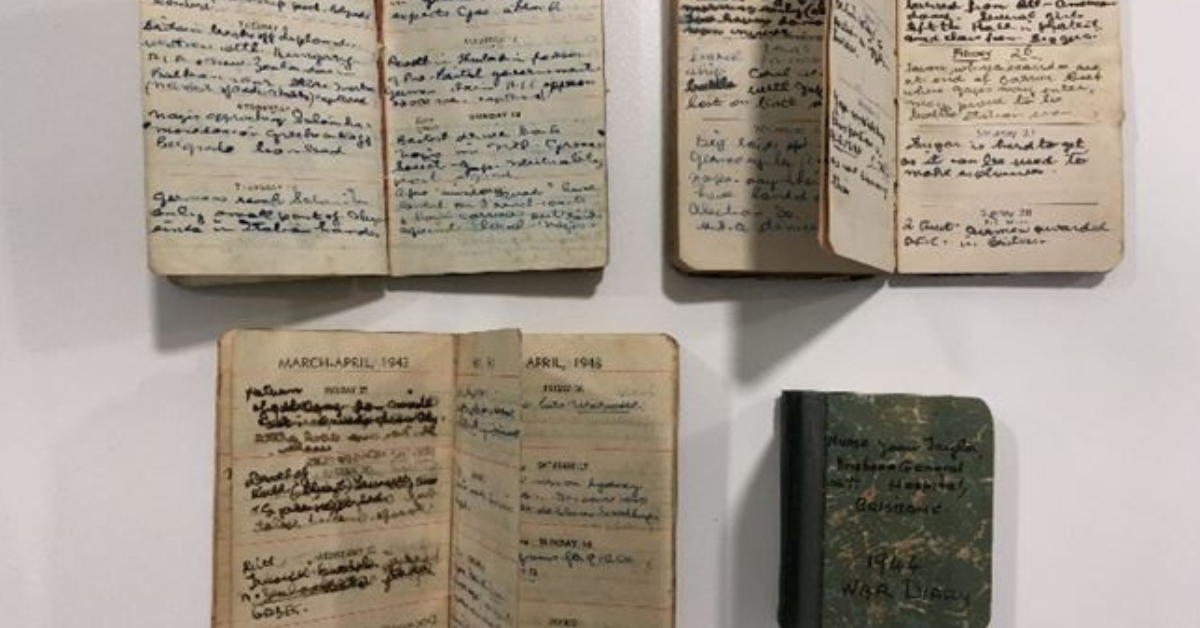
A set of war diaries kept between 1941 and 1944 by a young Annerley woman, Joan Taylor, provides a rare daily record of World War II’s impact on Brisbane. The diaries provide a unique and interesting glimpse of then-news about the global conflict, observations of local life and events, all written under the risk of wartime censorship.
A Personal War Record from Annerley
Joan Taylor’s four diaries document the years 1941 to 1944. When she began writing in 1941, Joan lived with her parents in the Brisbane suburb of Annerley, and she made it clear her goal was to create a record of the war’s development.

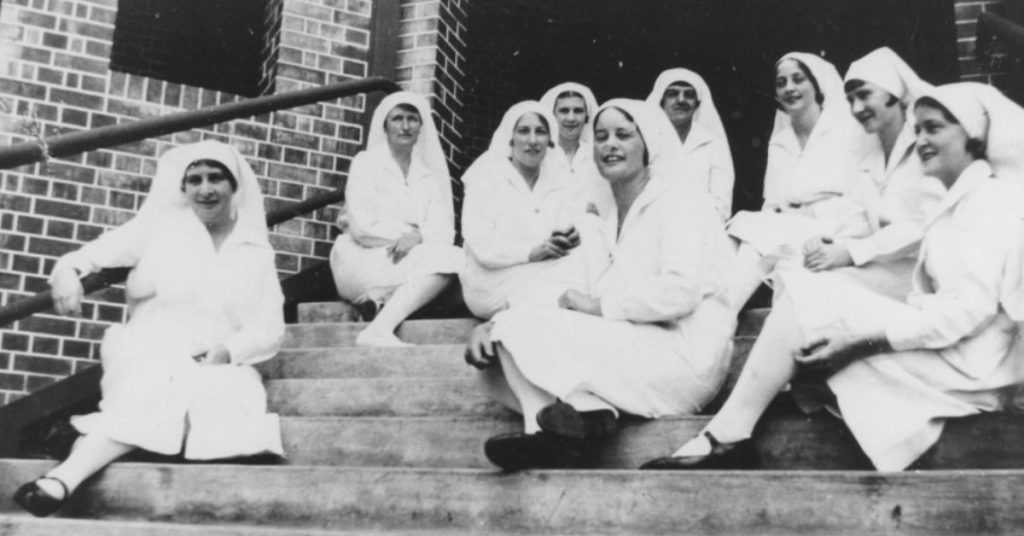
True to this aim, the diaries contain scant information about her personal life, focusing instead on daily events related to the conflict. By January 1943, her entries indicate she had moved into the nurses’ quarters at the Brisbane General Hospital.
Global Events Through Local Eyes
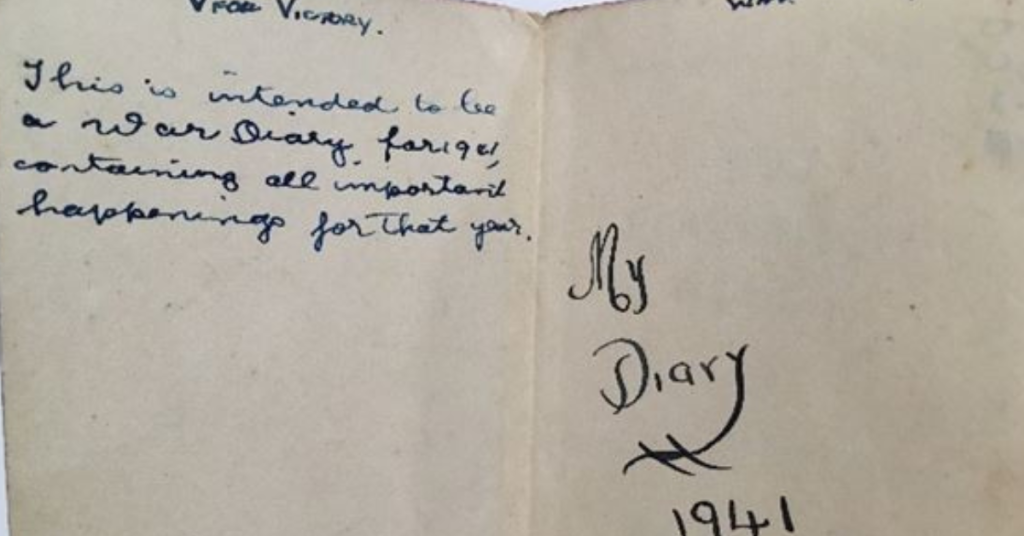
Joan filled her diary pages daily with headlines concerning the war, adding her observations and notes. Her entries from 1941 noted the arrival of an American fleet in Brisbane to a warm welcome in March, reported large numbers killed in the Belgrade massacre in April, and recorded Germany’s declaration of war on Russia in June, alongside Mr Churchill’s promise of British help.
Later that year, she remarked on clothes rationing in England and the use of “liquid hosiery,” a substitute for stockings that was also popular locally. A grim entry in November 1941 mentioned thousands of Jews being killed in Roumania. On 8 December 1941, she recorded the bombing of Hawaii and Manila by Japanese planes and Japan’s subsequent declaration of war on the US and Britain.
As the war progressed, she documented major turning points, including the massive Allied D-Day landings in France in June 1944, the liberation of Paris in August 1944, President Roosevelt winning a fourth term in the US in November 1944, and the bombing of Tokyo later that month.

War Comes to Brisbane
As the war intensified in the Pacific, Joan’s diaries reflected the growing threat and changes felt directly in Australia, particularly Queensland. In early 1942, she recorded the arrival of thousands of US soldiers, a significant round-up of enemy aliens in Queensland, the surrender of Singapore, and the shocking bombing of Darwin by Japanese forces. Life in Brisbane itself changed, with entries describing air raid practices, surprise blackouts, and the introduction of sugar rationing limiting each person to one pound (about 450 grams) per week.
She also noted the decision to employ 100 women as tram conductresses and observed an increase in stabbings occurring during quarrels in Brisbane later in 1942. The threat remained palpable into 1943, with entries mentioning Japanese raids on Darwin, the sinking of two Japanese transports off the North Australian coast, and an enemy plane being sighted and fired upon near Sydney. Local shortages became acute, with Joan writing in late 1943 about an extreme lack of meat that saw hundreds turned away from butcher shops daily.
Unofficial Reports and Local Crises
Some of Joan Taylor’s entries were marked with notes like “private information” or “not in newspapers,” suggesting she recorded details that might not have passed official wartime censorship. This information, possibly heard through word-of-mouth, included incidents of local violence. An April 1942 entry under “private information” alleged that two Black soldiers were shot in Brisbane for attacking women.
In July 1942, she wrote that witnesses claimed many were killed in a Townsville raid, despite official reports stating no casualties. Another shocking incident recorded in August 1942 involved an Allied soldier seriously wounding a girl at the Lyceum Theatre before killing himself. The diaries also touched on local health issues, noting a significant typhoid outbreak in Melbourne in May 1943 and increased cases of Scarlet Fever in Brisbane later that year.
That same May, the hospital ship Centaur was sunk by the Japanese east of Brisbane; Joan recorded that the survivors were brought quietly to the hospital ward next to hers, likely to prevent public panic. Not all unofficial information was accurate; an early 1944 entry reported Mussolini’s death from stomach ulcers in a German clinic, which was incorrect.
A Fading Chronicle
As 1944 progressed, Joan Taylor’s dedication to daily entries seemed to lessen. Weeks sometimes passed without an entry, and those she made became shorter. The source material suggests this was due to the demands of her nursing work, personal matters taking precedence, or a growing weariness with the seemingly endless war.
Her final entry on 31 December 1944, reflected on reports of a sniper nearly hitting Churchill in Athens and quoted Hitler’s defiant speech claiming Germany would not lose the war, to which Joan added a sceptical parenthetical comment: “(oh yeah!)”.
Published Date 09-April-2025